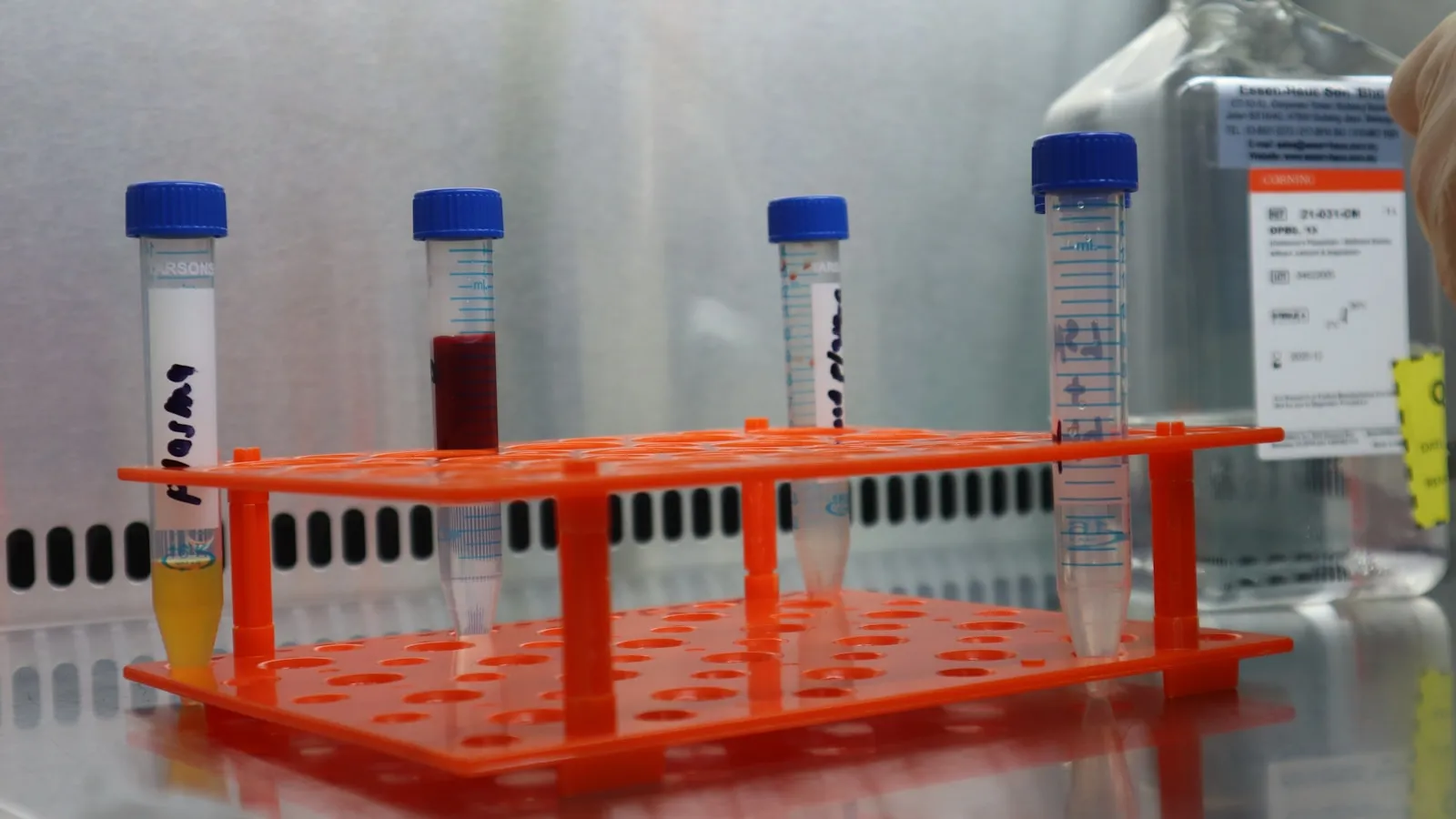
An elevated CDT value on your result usually raises one question straight away: does this mean I drink too much? Not necessarily. CDT is a strong marker for a pattern of chronic alcohol use, but it is not a lie detector, and there are reasons the value can be elevated without heavy drinking being the cause.
That is exactly why a reliable lab never looks at CDT alone. Below you will read what CDT actually measures, which causes can push a value up, and how to place an abnormal result in context.
What exactly does CDT measure?
CDT stands for carbohydrate-deficient transferrin, a form of the iron-transport protein transferrin with fewer sugar chains than normal. With prolonged heavy alcohol use, the share of this form increases. The result is usually given as a percentage (%CDT), with a reference value of generally below 2.8%. The half-life is around 14 to 17 days, so CDT reflects a pattern over roughly two to three weeks, not a single evening.
Our position: an elevated CDT is a reason to look further, not to draw a conclusion. One marker proves no alcohol problem.
Which causes can raise CDT?
The table below sets out the main causes, with the effect on CDT and how common they are. Only the first is alcohol-related; the rest show why context is indispensable.
| Cause | Effect on CDT | Explanation |
|---|---|---|
| Chronic heavy alcohol use | Elevated | The most common reason for an elevated %CDT |
| CDG syndrome (congenital glycosylation disorder) | Elevated, rare | Disturbs the sugar chains of transferrin without alcohol |
| Severe liver condition | Can disturb | Can affect the transferrin pattern |
| Recent blood transfusion | Can influence | Can temporarily distort the measurement |
| Iron overload or rare transferrin variants | Possibly elevated | Uncommon, but relevant for interpretation |
| One evening of heavy drinking | No effect | CDT responds to weeks, not to a single occasion |
What follows from this: an elevated CDT is usually alcohol-related, but the exceptions are real, and that is why the CBR and a doctor look at a combination of values. The Trimbos Institute describes CDT as a specific but not infallible marker, and the RIVM stresses that a single abnormal lab value always belongs in context.
What is CDT usually combined with?
To support a pattern, CDT is rarely assessed on its own. A frequently used set adds gamma-GT and MCV:
- Gamma-GT (GGT): a liver enzyme that can also rise from liver or gallbladder conditions and some medications.
- MCV: the average size of red blood cells, which can be elevated after prolonged heavy use.
If CDT, gamma-GT and MCV are all three elevated, the picture is stronger than with one abnormal value. This is exactly the set that weighs in at an assessment, as described in CDT value and your driving licence: what the CBR assessment involves.
What does an elevated CDT not prove?
Just as important as what CDT shows is what it does not do. An elevated value proves no single evening of heavy drinking: CDT responds to a pattern over weeks, not to a one-off excess. It also says nothing about when within those weeks drinking was heaviest, and it gives no exact number of drinks. And a normal CDT does not rule out occasional heavy drinking, simply because that marker is not set up for it.
Our position: anyone who reads an elevated CDT as conclusive proof of an alcohol problem moves too fast. It is a signal that calls for context, not a conclusion. Conversely, a clean CDT can be reassuring about a pattern, but is no free pass for the evening before.
What can you do about an elevated value?
An elevated CDT is not a final verdict. With full abstinence, an alcohol-related value usually falls back toward normal within two to three weeks, though after prolonged heavy use it can take longer. A repeated measurement therefore shows a line over time instead of a snapshot. If you want one value measured specifically, a CDT test for alcohol can quantify that for you, or you can have the CDT marker measured on its own.
The full explanation of all alcohol markers is in our pillar proving alcohol use: what CDT, EtG and a blood test show. What an abnormal value means for you personally is best discussed with a doctor.
Every blood test result at Zuivertest includes a professional assessment from a BIG-registered doctor. A test can provide clarity, but does not replace medical advice. For treatment decisions, discuss your results with your GP.
Sources
- Trimbos Institute, information on alcohol markers (trimbos.nl)
- RIVM, alcohol and health (rivm.nl)
الكاتب
Zuivertest
Dr. Naimi، طبيب مسجل في سجل BIG الهولندي، يشرف على المعايير الطبية لمحتوانا وتقييماتنا. اقرأ سياستنا الطبية