CDT test: what your value says about alcohol use
A CDT test measures chronic alcohol use over recent weeks. The Dutch guideline sets the cut-off at 2.0%.
Add to your order
No referral needed
Added to your order
Click the button to view your cart
Included Substances
1 substancesCDT (Carbohydrate-Deficient Transferrin)
A CDT test measures carbohydrate-deficient transferrin in your blood. That value rises with sustained heavy drinking, not after one night out. The Dutch guideline sets the cut-off for CDT at 2.0%.
What a CDT test measures
Transferrin is the protein that carries iron through your blood. It normally holds two carbohydrate chains. A breakdown product of alcohol disrupts how those chains attach. The result is carbohydrate-deficient transferrin, or CDT.
The laboratory reports the result as a percentage of total transferrin. That percentage climbs the more someone drinks. It reflects alcohol use across weeks, not yesterday.
The value only rises after at least a week of heavy drinking. In the literature that point sits around fifty to eighty grams of alcohol a day. That is roughly five to eight glasses a day. One standard glass counts as ten grams of alcohol in the Netherlands.
The cut-off for CDT is 2.0%
The Dutch guideline on alcohol misuse in driving fitness assessments gives two numbers. The upper limit of the normal reference interval is 1.7%. The cut-off used for assessment is 2.0%.
Above 2.0%, chronic heavy drinking is likely. Between 1.7% and 2.0% lies a grey zone. Measurement uncertainty is 0.3 percentage points. A raised CDT value just over the line therefore warrants a repeat.
These numbers belong to the standardised CDT-IFCC method. Some laboratories use CDT HPLC instead. So never place results from two methods side by side.
CDT and the CBR assessment
The CBR can require an assessment of your fitness to drive. This often follows a licence being withdrawn. That assessment includes laboratory testing for alcohol misuse.
The guideline names CDT as the most suitable parameter for it. Gamma-GT comes second. MCV, ASAT and ALAT were dropped in 2020. They proved insufficiently discriminating.
Please note: a test you order yourself is not a CBR assessment. The CBR appoints who carries the assessment out. Our result does not count toward it and does not replace it.
What you can use it for is tracking your own value. Some people do this during a period of abstinence over the longer term. You then know where you stand.
When a CDT test is useful
This measurement suits a question about a pattern, not about last night.
Consider it if you want to know how recent weeks read in measurable terms. Or if you are following a period of abstinence and want to see the decline.
If you stop drinking, the value usually returns to normal within two to three weeks. Anyone who drank heavily for years often needs longer. So CDT does fall during abstinence, just not at the same pace for everyone.
Want to know whether last night is still detectable? An EtG test suits that better.
What else can explain a raised result
The test is specific, but not infallible. The guideline reports a specificity of 91 to 96 percent. Sensitivity sits lower, between 36 and 51 percent.
That means two things. A raised result usually does have to do with alcohol. But a normal result does not rule heavy drinking out.
Other explanations are rare. One is an inherited fault in how sugars attach to proteins, known as CDG. Pregnancy, iron deficiency and liver disease can also disturb the measurement. In women and in obesity the test is less sensitive.
How the blood draw works
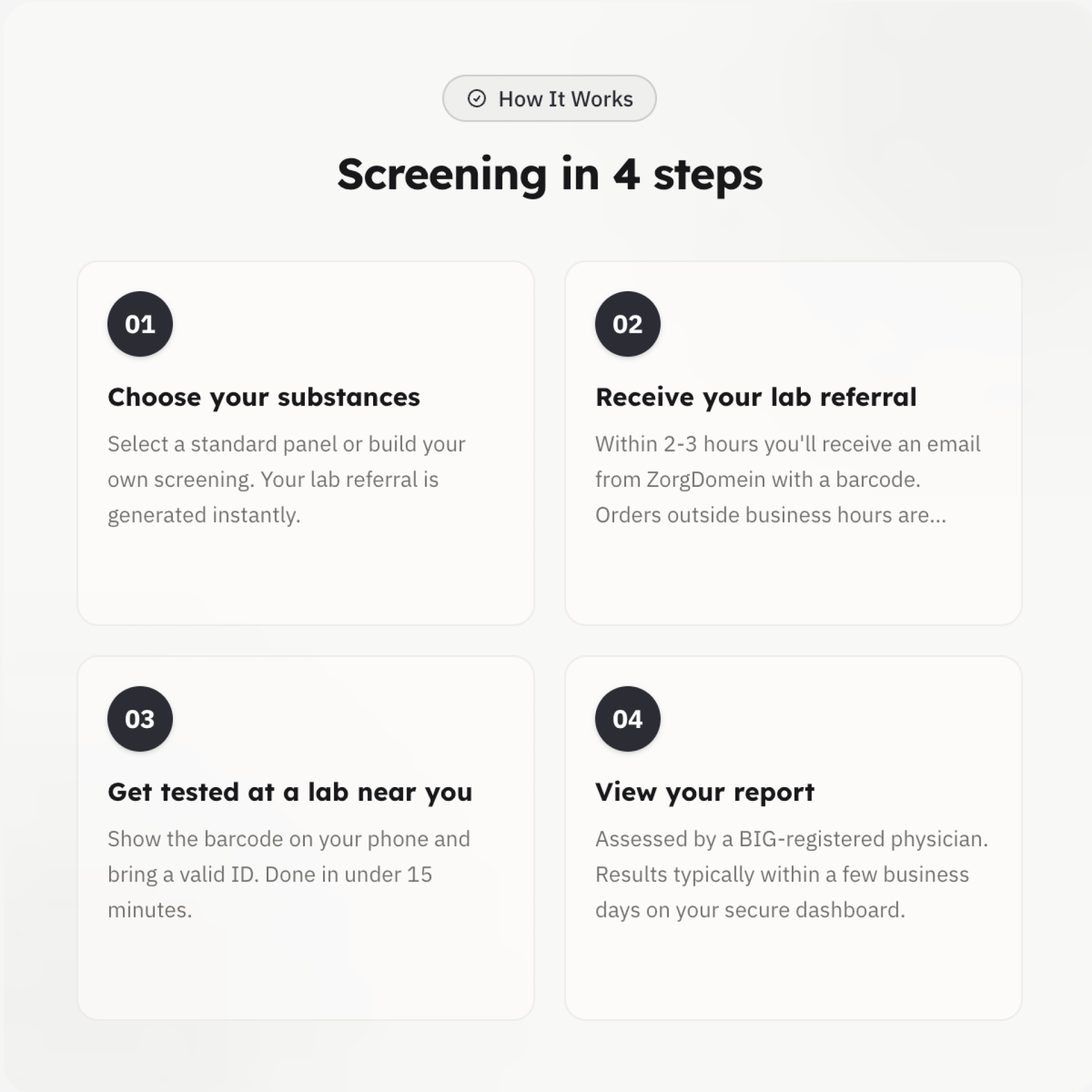
This measurement needs blood from a vein. The draw takes place at an affiliated collection point near you. You do not need to fast, and no referral is required.
The draw itself takes a few minutes. You receive the CDT percentage back, with the reference range alongside it.
Frequently asked questions
You do not need to stop drinking beforehand. The test looks back at the weeks before it. If you want to show a decline, allow at least two to three weeks of abstinence. After years of heavy use it takes longer.
The Dutch guideline sets the cut-off at 2.0%. The upper limit of the normal reference interval is 1.7%. Measurement uncertainty is 0.3 percentage points. A value just over the line is therefore not conclusive on its own.
Up to 1.7% counts as normal on the standardised CDT-IFCC method. Laboratories may apply small differences in reference values. So always read the range printed on your own result.
Not from one evening with this measurement. It shows a pattern across roughly two to four weeks. For recent use, other tests suit better, such as EtG in urine.
Gamma-GT is a liver value and rises from far more than alcohol alone. This measurement is more specific. The guideline places CDT first and gamma-GT second.
What We Screen For
| No. | Biomarker | Unit | Turnaround |
|---|---|---|---|
| 01 | CDT (Carbohydrate-Deficient Transferrin) | % | 7 days |
| Your result arrives once the slowest test is finished: 7 days. This is indicative; turnaround varies per laboratory. | |||
Preparation
Nothing special is needed for these tests.
- Water is always fine. Drink as usual beforehand, it makes the draw easier.
- Take your usual medication, unless your own doctor told you otherwise.
Extend this panel
Same draw, no second appointment.
Related Panels
Cocaine Screening
Individual cocaine metabolite screening with laboratory confirmation.
Ketamine Screening
Individual ketamine metabolite screening with laboratory confirmation.
Amphetamine Screening
Individual amphetamine screening with laboratory confirmation.