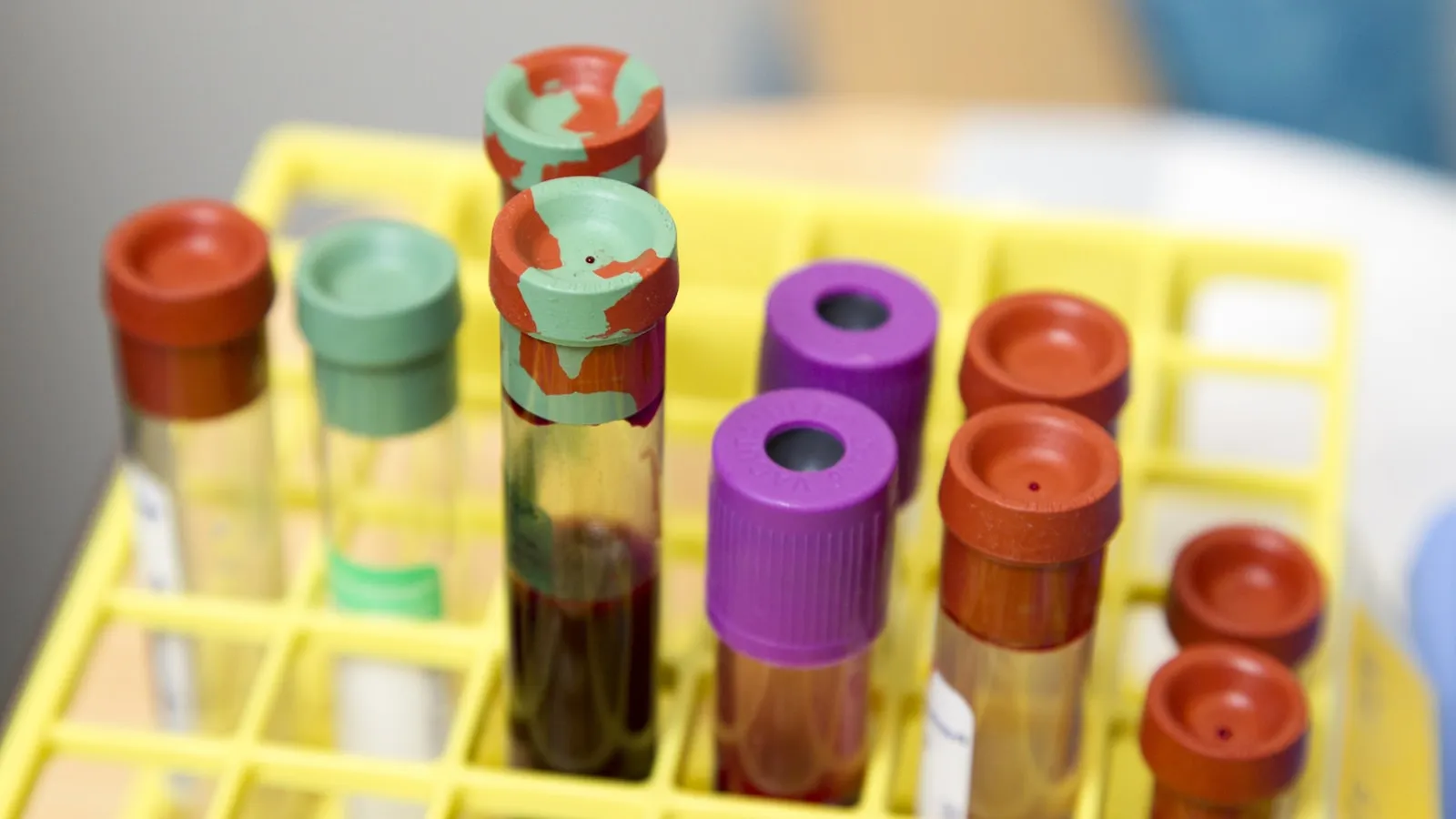
A raised gamma-GT means your liver is reacting to something. It does not mean you drink too much. Of the routine markers, gamma-GT is the least specific: in one comparative study its specificity was 76 percent, against 97 percent for CDT (PMID 11003208).
Gamma-GT is a sensitive alarm with a poor sense of direction. It goes off for alcohol, and just as readily for excess weight, fatty liver, medication or a bile duct problem.
What is gamma-GT and why does it rise?
Gamma-GT is an enzyme found mainly in the liver and the bile ducts. As soon as liver cells come under strain or bile flow stalls, more of the enzyme leaks into your blood. Alcohol also actively drives up its production, which is why the value is often the first to stand out in drinkers.
Standing out first does not make it proof.
How high may your gamma-GT be?
The reference range differs per laboratory and per sex, but runs roughly up to about 55 U/L in men and about 38 U/L in women. Your own lab report always states the range that laboratory uses. Compare your number with that, not with a number from the internet.
A mildly raised value says little on its own. Doctors look at the pattern: are ASAT, ALAT and bilirubin raised too, or is gamma-GT the only outlier?
Is a raised gamma-GT dangerous?
The value itself is not dangerous. It is a signal. A higher gamma-GT does track with a less favourable cardiometabolic profile. The Framingham Heart Study followed 3,451 participants. There, gamma-GT predicted the onset of metabolic syndrome, with a hazard ratio of 1.26 per standard deviation (PMID 17095717).
That is a reason to find the cause. It is not a reason to panic about a single number.
Which medicines and conditions raise gamma-GT?
More than most people think. Enzyme-inducing medicines, obstruction of the bile ducts and fatty liver are all on the list, alongside alcohol (PMID 11563810). Even a gamma-GT still inside the reference range already tracks with fatty liver and metabolic syndrome (PMID 21494075).
The sharpest figure comes from a study in people whose liver disease had nothing to do with alcohol. There, the specificity of gamma-GT collapsed to 52.9 percent in hepatitis and 35.0 percent in non-alcoholic cirrhosis. In those same groups CDT held on to 88.2 and 70.0 percent (PMID 16185209).
Put differently: in two out of three people with non-alcoholic liver cirrhosis, gamma-GT is raised with no alcohol involved at all.
Gamma-GT, CDT, EtG or MCV: which marker says what?
All four measure something different, and all four look back over a different period. That is exactly why a doctor usually orders more than one. Below they sit side by side, with the figures from Reynaud's comparative study (PMID 11003208).
| Marker | What it measures | Looks back | Sensitivity | Specificity | What else raises it |
|---|---|---|---|---|---|
| Gamma-GT | Liver enzyme | Weeks to months (half-life 26 days) | 42% | 76% | Excess weight, fatty liver, medication, bile ducts, diabetes |
| CDT | A variant of transferrin in the blood | About 2 to 3 weeks | 67% | 97% | Rare transferrin variants, severe liver disease |
| MCV | Average size of red blood cells | Months | 24% | 96% | Vitamin B12 or folate deficiency, thyroid disorder |
| EtG (urine) | A direct breakdown product of ethanol | About 40 to 130 hours after heavy use | Dose-dependent | Very high: EtG only forms from ethanol | Almost nothing |
The EtG window comes from a study of 32 heavy drinkers. There the urine value stayed above the cut-off for 40 to 130 hours, with a median of 78 hours (PMID 18971292).
Say you have two men, both with a gamma-GT of 90 U/L. One drinks six glasses a day. The other does not drink at all, but has a fatty liver at a BMI of 32. Their liver value is identical. Their CDT almost certainly will not be.
That is the entire reason CDT exists.
Which marker fits which question?
Pick the marker that matches your question, not the marker that happened to be on your GP's report. The question "did I drink last weekend" needs a different marker from the question "have I been drinking too much for months".
- Did I drink in the past few days? EtG in urine.
- Do I drink heavily as a sustained pattern? CDT in blood.
- Is my liver under strain, from whatever cause? Gamma-GT, together with ASAT and ALAT.
Zuivertest measures CDT and EtG. Gamma-GT and MCV are not part of our offering: those you request through your GP. If you want to know what your CDT is doing, a CDT test for alcohol will quantify that value, and the CDT marker page explains how to read the number.
How long does it take for gamma-GT to fall again?
More slowly than most people hope. The half-life of gamma-GT during abstinence has been calculated at 26 days (PMID 2859812). In patients without significant liver disease, the value had normalised in 80 percent of cases eight weeks after stopping (PMID 2857631). Where there was liver damage, it stayed high for longer.
That explains something that regularly causes confusion: someone who has not drunk for three weeks can still show a raised gamma-GT. The value lags behind the behaviour.
What should you do about a high gamma-GT?
Find the cause rather than assuming it. Discuss the result with your GP, bring your medication list, and ask whether the rest of the liver profile is moving with it. The Dutch Farmacotherapeutisch Kompas notes per drug whether it can affect liver values, and the NHG guidelines describe how GPs follow up an abnormal liver profile.
If the alcohol question is genuinely in play, a CDT value tells you more than a second gamma-GT. I see that confusion often: people have the same non-specific marker drawn again, and end up no wiser.
A raised CDT has pitfalls of its own, and those are covered in CDT too high. The complete overview of the alcohol markers is in detecting alcohol. If you first want to know how much you actually drink, start with the standard drink. And if medication is on your list, alcohol and medication is the piece that belongs alongside it.
Every blood test result at Zuivertest includes a professional assessment by a BIG-registered doctor. Discuss your results with your GP before making treatment decisions.
Sources
- Reynaud M. et al., "Objective diagnosis of alcohol abuse: compared values of CDT, GGT and MCV", Alcoholism: Clinical and Experimental Research, 2000 (PMID 11003208)
- Hock B. et al., "Validity of CDT, gamma-GT and MCV as biomarkers for chronic alcohol abuse", Addiction, 2005 (PMID 16185209)
- Orrego H. et al., "Relationship between gamma-glutamyl transpeptidase and mean urinary alcohol levels in alcoholics", Alcoholism: Clinical and Experimental Research, 1985 (PMID 2859812)
- Moussavian S.N. et al., "Serum gamma-glutamyl transpeptidase and chronic alcoholism", Digestive Diseases and Sciences, 1985 (PMID 2857631)
- Lee D.S. et al., "Gamma glutamyl transferase and metabolic syndrome, cardiovascular disease, and mortality risk: the Framingham Heart Study", Arteriosclerosis, Thrombosis, and Vascular Biology, 2007 (PMID 17095717)
- Whitfield J.B., "Gamma glutamyl transferase", Critical Reviews in Clinical Laboratory Sciences, 2001 (PMID 11563810)
- Oh H.J. et al., "Association of serum ALT and GGT levels within the reference range with metabolic syndrome and nonalcoholic fatty liver disease", Korean Journal of Hepatology, 2011 (PMID 21494075)
- Helander A. et al., "Detection times for urinary ethyl glucuronide and ethyl sulfate in heavy drinkers", Alcohol and Alcoholism, 2009 (PMID 18971292)
- Farmacotherapeutisch Kompas (farmacotherapeutischkompas.nl) and the NHG guidelines (nhg.org)
Author