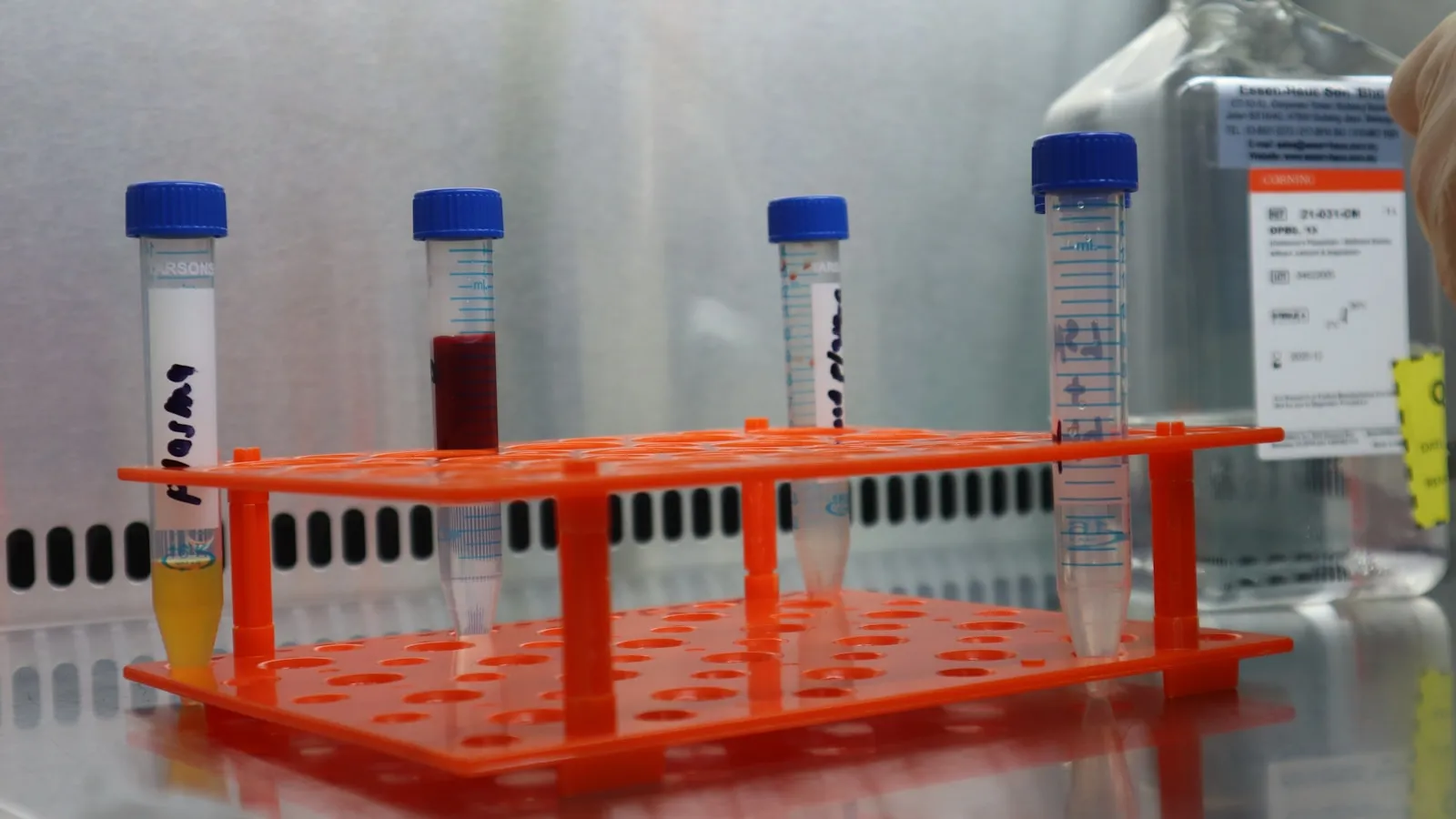
"How long am I still detectable?" It is the question most people ask after an evening of drinking, before an assessment, or when they want to know whether an earlier period is still visible. The honest answer: it does not depend on the alcohol itself, but on what you measure and in which material. Blood, urine and hair each give a completely different window.
Alcohol as a molecule disappears quickly. That is why, for a longer look back, a lab does not look at alcohol but at the breakdown products and biomarkers that use leaves behind. Below we set out the three matrices, with indicative times and the factors that shift them.
Why does alcohol leave the blood so quickly?
The body breaks down alcohol at a fairly fixed pace. The Trimbos Institute uses a rule of thumb of roughly one standard drink per hour. As a result, alcohol itself is usually measurable in blood for a few hours up to about a day, depending on the amount. A blood-alcohol reading or breath test therefore shows only very recent use, not what you drank last week.
Our position: anyone who wants to know whether a use pattern over weeks or months is still visible gains nothing from a breath test. That calls for other markers, which the body retains for longer.
Which window belongs to which matrix?
The table below sets the three matrices side by side: what is measured, how long it stays detectable, and what that window is useful for. The times are indicative for average use; with frequent or heavy use they are higher.
| Matrix | What is measured | Indicative window | Useful for |
|---|---|---|---|
| Blood (alcohol itself) | Ethanol | A few hours up to ± 1 day | Very recent use at the moment of measuring |
| Urine (EtG) | Ethyl glucuronide | ± 1 to 3 days | Recent use, even after the alcohol itself has cleared |
| Blood (CDT) | Carbohydrate-deficient transferrin | ± 2 to 3 weeks | Pattern of chronic heavy use |
| Blood (PEth) | Phosphatidylethanol | ± 2 to 4 weeks | More recent pattern, sensitive to moderate use |
| Hair (EtG) | Ethyl glucuronide | ± 1 month per cm, up to ± 3 months | Long look back and demonstrating abstinence |
What stands out: blood and urine only capture the recent window, while a hair test looks back months. No single matrix covers everything. The choice therefore always starts with the question, not with the test.
Which factors shift the window?
The indicative times above are not guarantees. The RIVM and the Trimbos Institute stress that individual factors can shift the window considerably:
- Amount and frequency: heavy or daily use lengthens almost every window.
- Metabolism and liver: how fast the body breaks down alcohol differs per person and per liver function.
- Body composition and fluids: influence distribution and excretion.
- For hair: hair length determines the look-back period; cosmetic treatments can affect EtG.
That is why a quantified lab value with a reference range offers more grip than a rough estimate. A CDT test for alcohol, for example, shows whether a pattern over recent weeks falls within or outside the reference range.
Why EtG stays detectable longer than alcohol itself
A common misconception is that a test is "empty" as soon as the alcohol has left the blood. That is true for a blood-alcohol reading, but not for EtG. EtG (ethyl glucuronide) is in fact formed when the body breaks down alcohol and then stays detectable in urine and hair for some time, even when the alcohol itself is long gone. That is why an EtG urine test can show use at a moment when a breath test shows nothing.
This explains why the choice of matrix is so decisive. Anyone thinking only of "the alcohol itself" greatly underestimates how long use stays visible. Our position: for the question of whether drinking occurred recently, you look at EtG in urine, not at the presence of alcohol in blood.
A concrete example per question
To make the choice tangible, three common situations:
- "Is last night's drinking still in my system?" A blood-alcohol reading shows that for at most a few more hours; EtG in urine can show it for up to about three days.
- "Have I been drinking too much in recent weeks?" CDT in blood reflects a pattern over two to three weeks, optionally supplemented with gamma-GT and MCV.
- "Can I demonstrate that I drank little or nothing for months?" An EtG hair test looks back the furthest and can make abstinence over months plausible.
Each of these questions calls for a different test. Anyone who chooses the wrong matrix gets a correctly performed measurement that simply covers the wrong period.
Which test fits your timing question?
Choose the matrix based on the period you want to cover: blood alcohol or EtG urine for the past hours to days, CDT in blood for the past weeks, and an EtG hair test for a look back of months. A full comparison of the alcohol markers is in our pillar proving alcohol use: what CDT, EtG and a blood test show. How long other substances stay detectable is in how long do drugs stay detectable.
At Zuivertest you decide which marker to have measured, only you see the result, and every result includes an assessment by a BIG-registered doctor. A test can provide clarity, but does not replace medical advice. For treatment decisions, discuss your results with your GP.
Sources
- Trimbos Institute, National Drug Monitor, alcohol (trimbos.nl)
- RIVM, alcohol and health (rivm.nl)
Autor
Zuivertest
Dr. Naimi, lekarz wpisany do holenderskiego rejestru BIG, nadzoruje standardy medyczne naszych treści i ocen. Przeczytaj naszą politykę medyczną