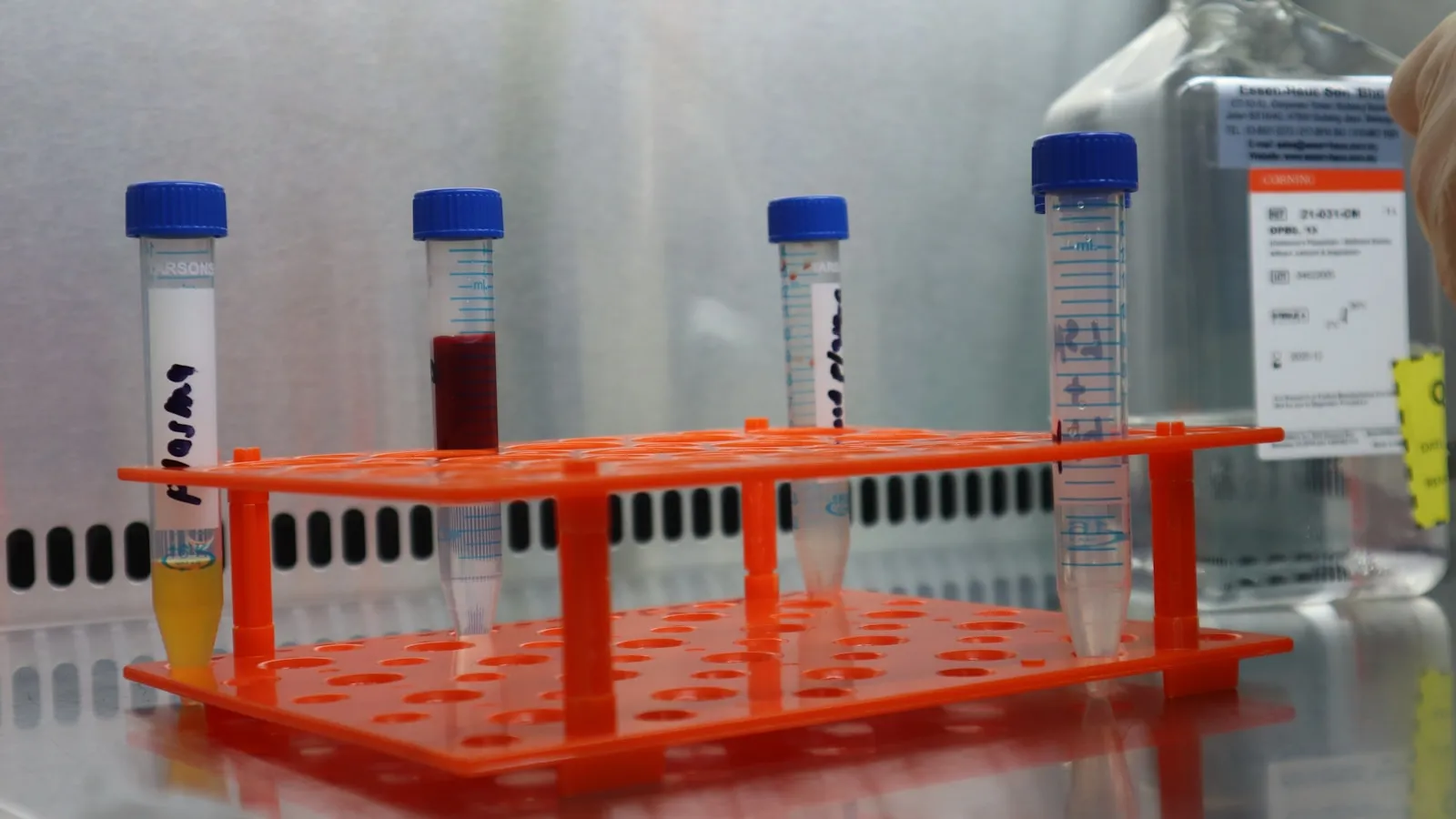
What a test still sees after a heavy night depends on which test you mean. Your blood is usually alcohol-free within a day. EtG in your urine can stay detectable for 40 to 130 hours after heavy use (PMID 18971292). And your CDT probably will not move at all.
Those three answers to one evening cause most of the misunderstandings I run into.
What is meant by binge drinking?
Binge drinking means drinking enough in a short time that your blood alcohol rises sharply. In practice the working definition is often four glasses for women and six for men within about two hours. The Dutch RIVM tracks this behaviour in its Leefstijlmonitor, because it is separate from the question of how much someone drinks across a whole week.
Someone can drink nothing during the week and still binge heavily at the weekend. For your body that is a different pattern from a daily glass, and for a test it is too.
What happens in your body during and after a binge?
More than a hangover. In healthy volunteers, a single binge raised the amount of endotoxin in the blood, along with bacterial DNA from the gut. Inflammatory messengers such as TNF-alpha and IL-6 rose too (PMID 24828436). The gut wall becomes temporarily more permeable, and the immune system responds.
Notable in that study: at the same intake, women had a higher blood alcohol level and more endotoxin than men.
Your heart notices too. In a study where participants drank an average of 8.4 standard drinks, heart rate rose from 72 to 80 beats per minute and heart rate variability fell during the hangover phase (PMID 33548379). Three participants developed atrial fibrillation, at 11, 29 and 34 hours after the binge.
Those were three people in a small group, so do not read it as a probability that applies to you. Read it as the reason the phenomenon acquired a name.
How fast does your body break alcohol down?
Roughly 0.15 grams per litre of blood per hour, as a rule of thumb for a moderate drinker. A large forensic review found a spread of 0.10 to 0.15 g/L per hour in fasted participants and 0.15 to 0.20 in those who had eaten (PMID 20304569). In heavy drinkers the rate runs higher, up to 0.35 g/L per hour.
What that means: eight glasses are not gone in four hours. Coffee, a shower and a brisk walk change nothing, because the liver sets the pace.
What does a test still see the next day?
That varies by test, and the variation is large. Blood and breath look at the alcohol itself and are therefore short-lived. Urinary EtG looks at a breakdown product and stays positive far longer. CDT looks at a pattern spanning weeks and simply does not see a single evening.
| Time since the last glass | Blood or breath test | EtG in urine | CDT in blood |
|---|---|---|---|
| 0 to 6 hours | Detectable, falling by about 0.15 g/L per hour | Detectable | Unchanged |
| 6 to 12 hours | Often still detectable after a heavy night | Detectable | Unchanged |
| 12 to 24 hours | Usually no longer detectable | Usually still detectable | Unchanged |
| 24 to 48 hours | Not detectable | Variable, often already negative at six glasses or fewer | Unchanged |
| 48 to 130 hours | Not detectable | Only after heavy or sustained use | Unchanged |
Those last two rows deserve an explanation. The often-quoted "80 hours" for EtG comes from research in heavy drinkers. After a single evening the window is shorter and strongly dose-dependent: in a dose-ranging study, sensitivity at 48 hours was low following six drinks or fewer (PMID 24773137).
Say you drink 8 glasses on Saturday evening and get screened on Monday morning. Your blood has been alcohol-free for well over a day. Your urine may still contain EtG. Your CDT has not moved.
Does one heavy night raise your CDT?
Almost certainly not. CDT responds to sustained heavy use, not to a single peak. In a controlled study, 51 healthy men drank 20 to 80 grams of alcohol daily for three weeks. Even in the groups on 80 grams a day, the CDT percentage did not change significantly in most subjects (PMID 8844032).
The researchers concluded that CDT is not sensitive for short-term heavy drinking in healthy people. That is precisely what makes the marker useful in assessments: it does not pick up the noise of a weekend.
How to read a CDT value in context is set out in detecting alcohol. A raised liver value after a period of drinking is a different story again, and that is covered in gamma-GT too high.
Is binge drinking worse than a daily glass?
For some risks, yes. The peak load of eight glasses in one evening does something different to your heart, gut and immune system than eight glasses spread across a week. There is a reason the Dutch Gezondheidsraad advises a daily maximum and not only a weekly total.
I would not push the comparison too far. Both patterns carry risk. They simply do not carry the same risk.
What you can have measured
If you want to know what is in your urine, ethyl glucuronide looks at recent alcohol use. If you want to know whether your drinking pattern over weeks is visible, a CDT test for alcohol is the marker that belongs to that question.
If you are not sure how many glasses you actually drink, start with the standard drink. When pouring at home, one glass is rarely one glass. And the full overview of detectability per matrix sits in how long alcohol is detectable.
Every blood test result at Zuivertest includes a professional assessment by a BIG-registered doctor. Discuss your results with your GP before making treatment decisions.
Sources
- Helander A. et al., "Detection times for urinary ethyl glucuronide and ethyl sulfate in heavy drinkers during alcohol detoxification", Alcohol and Alcoholism, 2009 (PMID 18971292)
- Jatlow P.I. et al., "Ethyl glucuronide and ethyl sulfate assays in clinical trials, interpretation, and limitations", Alcoholism: Clinical and Experimental Research, 2014 (PMID 24773137)
- Voskoboinik A. et al., "Acute electrical, autonomic and structural effects of binge drinking: insights into the holiday heart syndrome", International Journal of Cardiology, 2021 (PMID 33548379)
- Bala S. et al., "Acute binge drinking increases serum endotoxin and bacterial DNA levels in healthy individuals", PLoS One, 2014 (PMID 24828436)
- Lesch O.M. et al., "Carbohydrate-deficient transferrin as a marker of alcohol intake: a study with healthy subjects", Alcohol and Alcoholism, 1996 (PMID 8844032)
- Jones A.W., "Evidence-based survey of the elimination rates of ethanol from blood", Forensic Science International, 2010 (PMID 20304569)
- RIVM, Leefstijlmonitor, figures on heavy and excessive drinking (rivm.nl)
- Gezondheidsraad, Dutch dietary guidelines (gezondheidsraad.nl)
Author
Zuivertest
Dr. Naimi, BIG-registered physician, oversees the medical standards behind our content and assessments. Read our medical policy