Extended 10-Panel
Broad 10-substance screening covering CDT, cocaine, ketamine, amphetamines, 3-MMC, LSD, GHB, phenibut, heroin marker, and opiates.
Add to your order
No referral needed
Added to your order
Click the button to view your cart
Included Substances
10 substancesThis panel provides a broad screening for ten substances, combining a blood sample for CDT with a urine sample for nine substance metabolites. It includes substances with both longer and very short detection windows.
Why this test?
The Extended 10-Panel covers the same five substances as the Core 5-Panel (CDT, cocaine, ketamine, amphetamines, and 3-MMC) and adds five additional substances: LSD, GHB, phenibut, 6-MAM (a heroin-specific metabolite), and opiates. This broader scope may be relevant when a wider range of substances is of interest.
Some of the additional substances have notably short detection windows. GHB, for example, may only be detectable in urine for approximately 8 to 12 hours after use, while 6-MAM (specific to heroin) has a window of approximately 2 to 8 hours. Timing of sample collection relative to last use is therefore particularly relevant for these substances.
Who is this test for?
This test may be relevant for:
- Individuals who wish to screen for a broader range of substances
- People who want a more extensive overview for personal or professional reasons
- Anyone seeking data on substances not covered by a standard 5-panel screening
What is tested?
The panel includes the following substances and metabolites:
- CDT (Carbohydrate-Deficient Transferrin): blood, expressed as %. Reflects consumption patterns over approximately two to four weeks.
- Cocaine metabolite (benzoylecgonine): urine. Detection window: approximately 2 to 4 days.
- Ketamine (norketamine): urine. Detection window: approximately 2 to 4 days.
- Amphetamines: urine. Detection window: approximately 2 to 4 days.
- 3-MMC: urine. Detection window: approximately 2 to 4 days.
- LSD: urine. Detection window: approximately 1 to 3 days.
- GHB: urine. Detection window: approximately 8 to 12 hours. This is a notably short window; timing of sample collection is particularly relevant.
- Phenibut: urine. Detection window: approximately 2 to 5 days.
- 6-MAM (heroin-specific metabolite): urine. Detection window: approximately 2 to 8 hours. Opiates may remain detectable longer.
- Opiates: urine. Detection window: approximately 2 to 4 days.
What can this test tell you?
Each substance is reported as detected or not detected based on laboratory thresholds. A positive result indicates that the substance or its metabolite was found above the reporting threshold. A negative result means it was not detected at the time of collection.
Due to the very short detection windows of some substances (particularly GHB and 6-MAM), a negative result does not necessarily rule out recent use. Conversely, a positive result confirms detection but does not indicate quantity or frequency of use. If a substance is detected, confirmation testing may be performed to verify the finding.
How is the sample collected?
This panel requires two types of samples, both collected at a certified sample point (afnamepunt):
- A blood draw for CDT analysis
- A urine sample (mid-stream) for all substance metabolite screening
The collection is carried out by trained personnel. Both samples are typically collected during the same visit.
When is this test useful?
This test may be considered when:
- A broader range of substances is relevant for the screening
- Insight into both longer-term patterns (via CDT) and recent use (via urine metabolites) is desired
- Substances with short detection windows (such as GHB or 6-MAM) are of interest, with the understanding that sample timing is particularly relevant
What do the results mean?
Results are presented per substance as detected or not detected. For CDT, the result is a percentage value, with elevated levels potentially indicating sustained alcohol consumption.
Given the varying detection windows across substances, interpretation should account for the timing of sample collection. For substances with very short windows (GHB, 6-MAM), a negative result may simply reflect that the detection window had passed. Results should be discussed with a healthcare provider for proper interpretation.
Preparation
No specific preparation is required for the blood draw. For the urine sample, collect a mid-stream sample at the sample point. Hydrate normally beforehand; over-hydration may dilute the sample. If screening for substances with short detection windows (such as GHB), the timing of sample collection relative to suspected last use is particularly relevant.
What happens after the results?
Results are typically available within a few working days. The report provides a per-substance overview of findings.
If any substance is detected in the initial screening, confirmation testing using a more specific laboratory method may be performed. The final report includes the confirmed results. A healthcare provider can assist with interpreting the findings in context.
Frequently Asked Questions
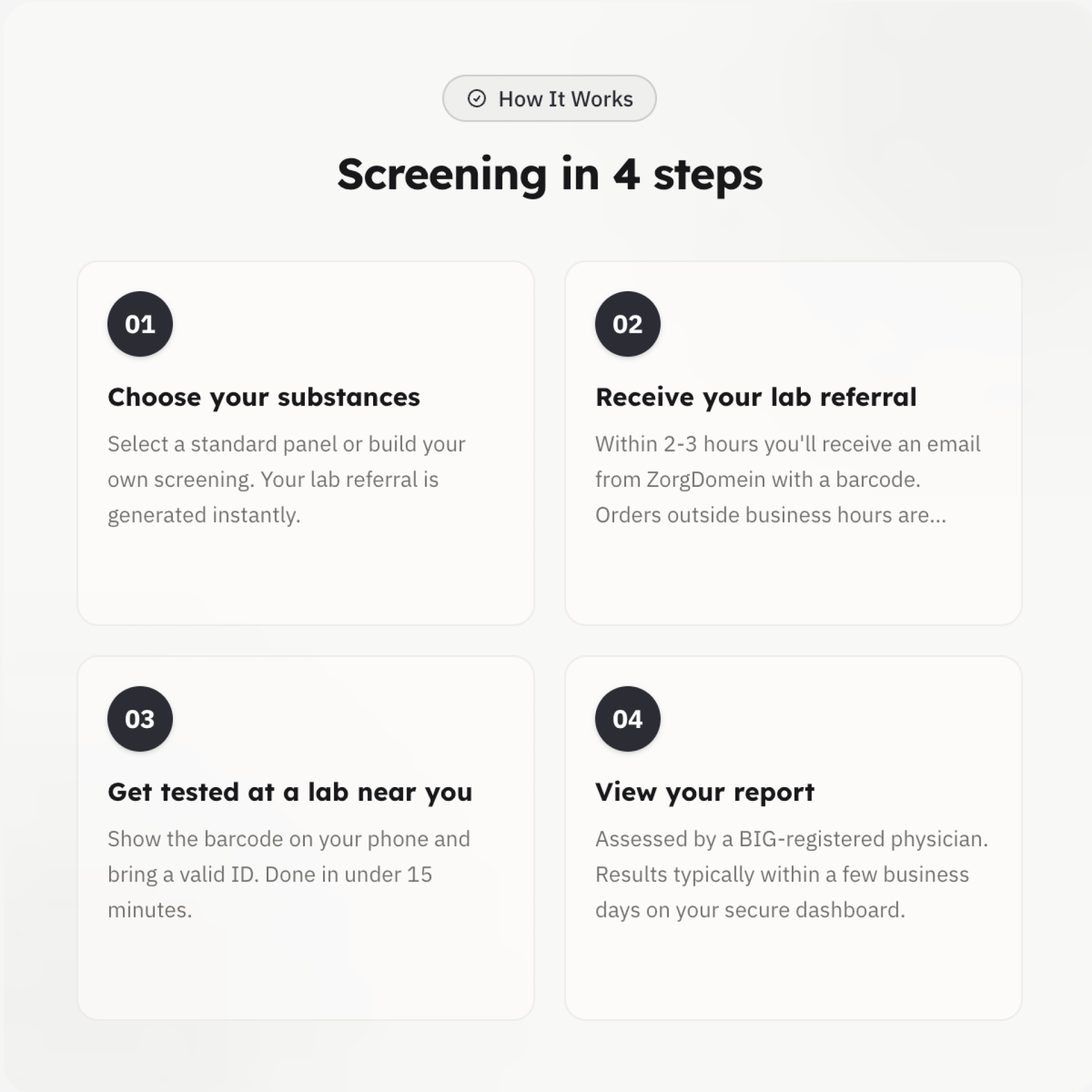
Screening in 4 steps
No referral, no waiting, no questions. Order, test, and receive your results on your dashboard.
Choose your substances
Select a standard panel or build your own screening. Your lab referral is generated instantly.
Receive your lab referral
Within 2-3 hours you'll receive an email from ZorgDomein with a barcode. Orders outside business hours are processed the next business day.
Get tested at a lab near you
Show the barcode on your phone and bring a valid ID. Done in under 15 minutes.
View your report
Assessed by a BIG-registered physician. Results typically within a few business days on your secure dashboard.
Choose your substances
Select a standard panel or build your own screening. Your lab referral is generated instantly.
Receive your lab referral
Within 2-3 hours you'll receive an email from ZorgDomein with a barcode. Orders outside business hours are processed the next business day.
Get tested at a lab near you
Show the barcode on your phone and bring a valid ID. Done in under 15 minutes.
View your report
Assessed by a BIG-registered physician. Results typically within a few business days on your secure dashboard.
Always a location near you
With more than 450+ certified phlebotomy points across the Netherlands.
What We Screen For
This panel screens for 10 substances to give you comprehensive results.
A 6-MAM urine test is a qualitative screening that detects the presence of 6-monoacetylmorphine (6-MAM) in urine. 6-MAM is a unique metabolite of heroin (diacetylmorphine) and its presence confirms heroin exposure specifically, rather than general opiate use.
Learn moreA CDT blood test measures carbohydrate-deficient transferrin, a biomarker that indicates chronic heavy alcohol consumption over the preceding weeks. CDT is considered one of the most specific markers for sustained excessive alcohol intake.
Learn moreA 3-MMC urine test is a qualitative screening that detects the presence of 3-methylmethcathinone (3-MMC) or its metabolites in urine. 3-MMC is a synthetic cathinone with stimulant and empathogenic properties.
Learn moreAn amphetamines urine test is a qualitative screening that detects the presence of amphetamine, methamphetamine, MDMA (ecstasy), and related compounds or their metabolites in urine. This test covers a broad class of central nervous system stimulants.
Learn moreAn LSD urine test is a qualitative screening that detects the presence of lysergic acid diethylamide (LSD) or its metabolites in urine. LSD is a potent synthetic psychedelic substance that produces effects at very low doses.
Learn moreA GHB urine test is a qualitative screening that detects the presence of gamma-hydroxybutyrate (GHB) in urine. GHB is a central nervous system depressant that occurs naturally in the body in trace amounts but may also be used as a recreational substance.
Learn moreA ketamine urine test is a qualitative screening that detects the presence of ketamine or its metabolites in urine. Ketamine is a dissociative anaesthetic used medically for anaesthesia and pain management, but may also be used as a recreational substance.
Learn moreAn opiates urine test is a qualitative screening that detects the presence of opiate compounds such as morphine, codeine, and their derivatives in urine. Opiates are a class of substances derived from the opium poppy or their semi-synthetic analogues.
Learn moreA cocaine urine test is a qualitative screening that detects the presence of cocaine and its primary metabolite benzoylecgonine in urine. Cocaine is a potent central nervous system stimulant derived from the coca plant.
Learn moreA phenibut urine test is a qualitative screening that detects the presence of phenibut or its metabolites in urine. Phenibut is a synthetic neurotropic compound that acts on GABA receptors and is not approved for medical use in many countries.
Learn more6-MAM (Heroin Marker)
Drug ScreeningA 6-MAM urine test is a qualitative screening that detects the presence of 6-monoacetylmorphine (6-MAM) in urine. 6-MAM is a unique metabolite of heroin (diacetylmorphine) and its presence confirms heroin exposure specifically, rather than general opiate use.
6-MAM testing provides definitive confirmation of heroin exposure. Standard opiate tests detect morphine, which can originate from heroin, codeine, or poppy seed consumption, making it impossible to confirm the specific source. The presence of 6-MAM eliminates ambiguity and is considered the gold standard for confirming heroin use in clinical, forensic, and workplace settings.
CDT (Carbohydrate-Deficient Transferrin)
Drug ScreeningA CDT blood test measures carbohydrate-deficient transferrin, a biomarker that indicates chronic heavy alcohol consumption over the preceding weeks. CDT is considered one of the most specific markers for sustained excessive alcohol intake.
CDT testing provides objective evidence of chronic heavy alcohol consumption that other alcohol markers may not capture. Unlike EtG, which detects recent alcohol exposure, CDT reflects a pattern of sustained heavy drinking over weeks. This makes CDT particularly valuable for treatment programme compliance monitoring, licence reinstatement evaluations, and clinical assessments where a longer-term drinking pattern is relevant.
3-MMC
Drug ScreeningA 3-MMC urine test is a qualitative screening that detects the presence of 3-methylmethcathinone (3-MMC) or its metabolites in urine. 3-MMC is a synthetic cathinone with stimulant and empathogenic properties.
Detection of 3-MMC is relevant for clinical assessment, substance use treatment monitoring, and forensic evaluations. Synthetic cathinones are an evolving class of substances that may not be identified by conventional drug screens. Accurate detection supports informed clinical decisions and helps assess patterns of novel psychoactive substance use.
Amphetamines
Drug ScreeningAn amphetamines urine test is a qualitative screening that detects the presence of amphetamine, methamphetamine, MDMA (ecstasy), and related compounds or their metabolites in urine. This test covers a broad class of central nervous system stimulants.
Amphetamine detection is a standard component of workplace drug screening, clinical toxicology assessment, and substance use treatment monitoring. These substances affect the cardiovascular and central nervous systems. It is important to note that certain prescribed medications, such as those for ADHD, may produce a positive result. Clinical context and confirmatory testing are essential for accurate interpretation.
LSD
Drug ScreeningAn LSD urine test is a qualitative screening that detects the presence of lysergic acid diethylamide (LSD) or its metabolites in urine. LSD is a potent synthetic psychedelic substance that produces effects at very low doses.
LSD detection is relevant for clinical toxicology, forensic investigations, and extended drug screening programmes. The substance is active at microgram doses, making detection analytically challenging. Targeted testing may be requested when LSD use is suspected in clinical or forensic settings where standard drug panels would not identify its presence.
GHB
Drug ScreeningA GHB urine test is a qualitative screening that detects the presence of gamma-hydroxybutyrate (GHB) in urine. GHB is a central nervous system depressant that occurs naturally in the body in trace amounts but may also be used as a recreational substance.
GHB detection is particularly challenging due to its very short detection window and the presence of endogenous GHB in the body. Timely testing is critical, as GHB may be undetectable in urine within hours of exposure. Accurate GHB detection is relevant for clinical toxicology, forensic investigations, and situations where drug-facilitated incapacitation is suspected.
Ketamine
Drug ScreeningA ketamine urine test is a qualitative screening that detects the presence of ketamine or its metabolites in urine. Ketamine is a dissociative anaesthetic used medically for anaesthesia and pain management, but may also be used as a recreational substance.
Ketamine detection is relevant for clinical assessment, substance use monitoring, and forensic evaluations. While ketamine has legitimate medical applications, its recreational use may be associated with urological, cognitive, and psychological effects. Targeted testing supports accurate identification and helps distinguish medical from non-medical use when clinical context is considered.
Opiates
Drug ScreeningAn opiates urine test is a qualitative screening that detects the presence of opiate compounds such as morphine, codeine, and their derivatives in urine. Opiates are a class of substances derived from the opium poppy or their semi-synthetic analogues.
Opiate screening is a standard component of workplace, clinical, and forensic drug testing panels. Detection may indicate prescribed opiate use, non-medical use, or exposure from dietary sources such as poppy seeds. Clinical context, medication history, and confirmatory testing are essential for accurate interpretation, as a positive result does not by itself indicate the specific opiate or the source of exposure.
Cocaine Metabolite
Drug ScreeningA cocaine urine test is a qualitative screening that detects the presence of cocaine and its primary metabolite benzoylecgonine in urine. Cocaine is a potent central nervous system stimulant derived from the coca plant.
Cocaine screening is a standard component of workplace, clinical, and forensic drug testing panels. Detection of benzoylecgonine indicates cocaine exposure within the relevant detection window. Accurate detection supports clinical assessment, treatment monitoring, and compliance verification in various professional and legal settings.
Phenibut
Drug ScreeningA phenibut urine test is a qualitative screening that detects the presence of phenibut or its metabolites in urine. Phenibut is a synthetic neurotropic compound that acts on GABA receptors and is not approved for medical use in many countries.
Phenibut use may be associated with dependence, withdrawal symptoms, and adverse effects on the central nervous system. Because phenibut is often not included in standard drug panels, targeted testing can be important for accurate clinical assessment. Consult a healthcare professional for interpretation of results.
Related Panels
Explore more screening panels that might be relevant for you.
Core 5-Panel
Screen for 5 commonly requested substances including CDT, cocaine, ketamine, amphetamines, and 3-MMC.
Alcohol (CDT) Test
CDT biomarker test designed to indicate chronic alcohol consumption patterns.
Cocaine Screening
Individual cocaine metabolite screening with laboratory confirmation.
This test not quite right?
Build your own blood test from 21+ individual biomarkers — choose exactly what you need.
Have a question?
Our team is happy to help. Ask your question and we'll respond as soon as possible.