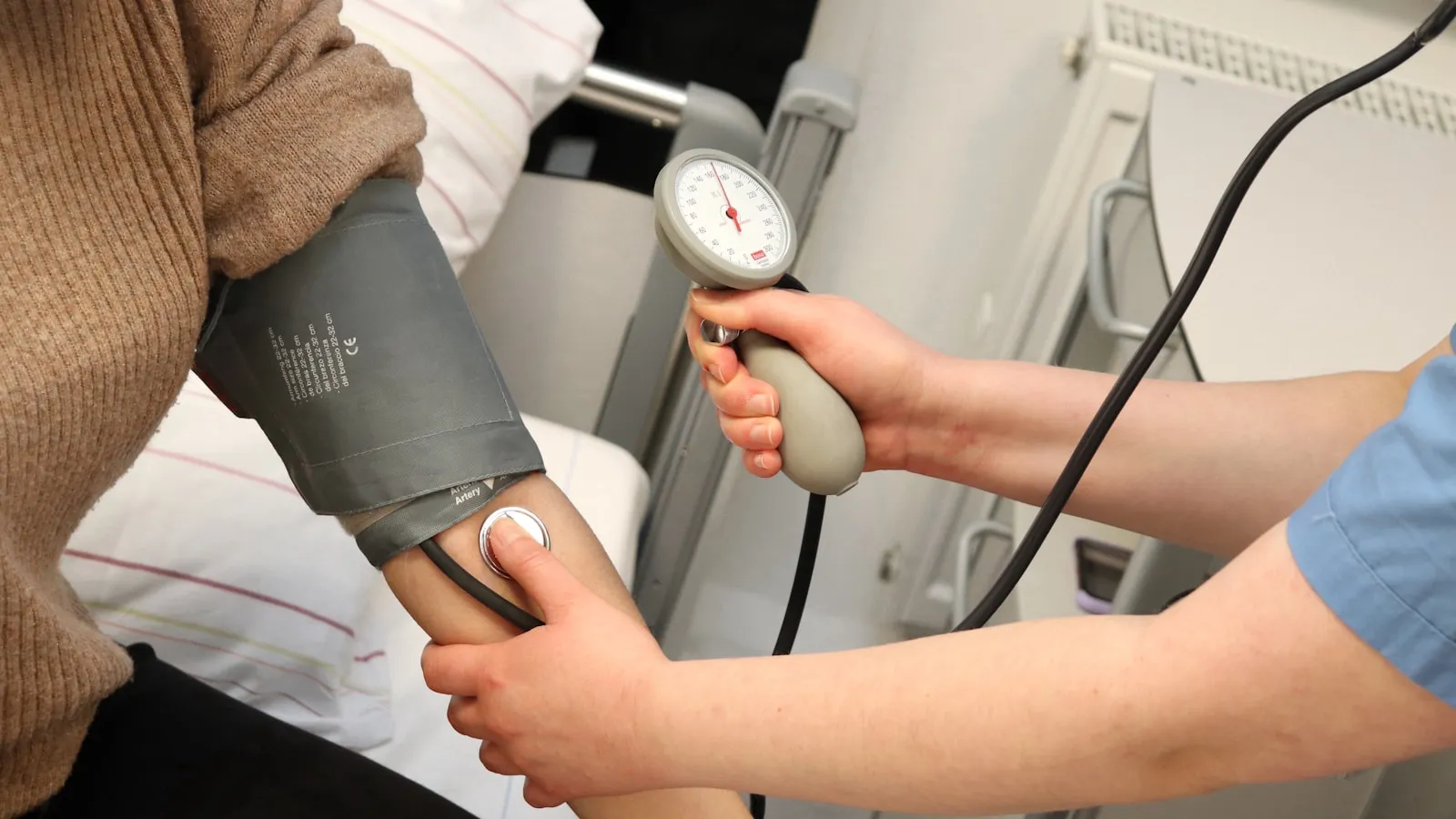
Alcohol raises your blood pressure, and how much you gain by cutting back depends on where you start. People drinking six glasses a day who halve their intake see systolic pressure fall by about 5.5 mmHg (PMID 29253389). People drinking two glasses a day who cut back measure almost no difference.
I find that one of the most honest numbers in lifestyle medicine. It promises the light drinker little, and the heavy drinker a lot.
Why does alcohol raise your blood pressure?
Alcohol works on several fronts at once. It activates your sympathetic nervous system, pushes up your heart rate and disturbs the vessel-widening function of the lining of your blood vessels. Your kidneys also retain more fluid. The net effect is higher pressure in the vessels, for as long as the drinking pattern lasts.
The Dutch Hartstichting therefore counts alcohol among the lifestyle factors that influence blood pressure, alongside salt, weight and exercise.
What is striking is that the effect starts at amounts most people consider normal.
Is there an amount that has no effect?
Probably not. A dose-response meta-analysis of more than 19,000 people found an almost straight line between intake and blood pressure, with no threshold below which the effect disappears (PMID 37522179). At twelve grams of alcohol a day, roughly one glass, systolic pressure averaged 1.25 mmHg higher than in non-drinkers.
At 48 grams a day, roughly five glasses, that became 4.90 mmHg. Diastolic pressure followed the same pattern, at 1.14 and 3.10 mmHg.
Those are averages across large groups. For you personally it may be more, or less.
What does one evening of drinking do to your blood pressure?
Something that surprises many people: in the first hours your blood pressure actually falls. A Cochrane review found that a high dose of alcohol lowers systolic pressure by about 3.5 mmHg within six hours (PMID 32609894). Then it reverses. More than thirteen hours later, that same systolic pressure sits an average of 3.7 mmHg higher than without alcohol.
Heart rate was raised at every measurement point in that review, by 5.8 beats per minute early on and still 2.7 later.
That explains why a reading the morning after a party can be so confusing. You are not measuring the alcohol. You are measuring the rebound.
How much does your blood pressure drop if you cut back or stop?
That depends entirely on your starting point. In a meta-analysis of 36 studies, systolic pressure only fell measurably in people who drank heavily. Below two glasses a day, cutting back produced no significant drop (PMID 29253389). Above six glasses a day, halving intake produced a substantial one.
| Situation | Effect on systolic pressure | Source |
|---|---|---|
| 12 grams a day (about 1 glass) versus not drinking | 1.25 mmHg higher | PMID 37522179 |
| 48 grams a day (about 5 glasses) versus not drinking | 4.90 mmHg higher | PMID 37522179 |
| Cutting back at 2 glasses a day or fewer | No significant drop | PMID 29253389 |
| Halving intake at 6 glasses a day or more | 5.50 mmHg lower (diastolic 3.97 lower) | PMID 29253389 |
| First 6 hours after a high dose | 3.5 mmHg lower (temporary) | PMID 32609894 |
| More than 13 hours after a high dose | 3.7 mmHg higher | PMID 32609894 |
Say you have two men of 45, both with a systolic pressure of 148. One drinks six glasses a day, the other two. If both halve their intake, the first drops by about 5.5 mmHg and the second barely changes. The same effort, a very different result.
How long does alcohol affect your blood pressure?
The acute swing has worked its way out within roughly a day. The structural rise has not, because that belongs to the pattern rather than to the glass. In the trials on cutting back, the measurement periods usually ran for weeks to months, so do not expect a difference after one alcohol-free evening.
For men the risk of high blood pressure also starts earlier than many assume. At one to two glasses a day, the chance of hypertension was already 19 percent higher than in non-drinkers (PMID 29950485). In women that difference only appeared from three glasses a day.
What a blood pressure monitor cannot see
Your blood pressure tells you something about the load on your vessels. It tells you nothing about how much you drank over the past weeks, because too many other things drive that number: stress, salt, sleep, weight, coffee.
Lab values work differently. CDT responds to a pattern of heavy drinking over roughly two to three weeks and is the most alcohol-specific of the routine markers. If you want to see that number, you can arrange a CDT test for alcohol without going through a doctor first.
How that marker compares with a raised liver value is covered in our piece on gamma-GT too high. The full overview of the alcohol markers sits in detecting alcohol. And anyone who notices their nights get worse after a few glasses may recognise the pattern in alcohol and sleep.
I would not steer on the blood pressure monitor alone. Two numbers that measure different things say more than one number that reads differently every morning.
Every blood test result at Zuivertest includes a professional assessment by a BIG-registered doctor. Discuss your results with your GP before making treatment decisions.
Sources
- Di Federico S. et al., "Alcohol Intake and Blood Pressure Levels: A Dose-Response Meta-Analysis of Nonexperimental Cohort Studies", Hypertension, 2023 (PMID 37522179)
- Roerecke M. et al., "The effect of a reduction in alcohol consumption on blood pressure: a systematic review and meta-analysis", Lancet Public Health, 2017 (PMID 29253389)
- Tasnim S. et al., "Effect of alcohol on blood pressure", Cochrane Database of Systematic Reviews, 2020 (PMID 32609894)
- Roerecke M. et al., "Sex-Specific Associations Between Alcohol Consumption and Incidence of Hypertension", Journal of the American Heart Association, 2018 (PMID 29950485)
- Hartstichting, information on blood pressure and lifestyle (hartstichting.nl)
Autor
Zuivertest
Dr. Naimi, lekarz wpisany do holenderskiego rejestru BIG, nadzoruje standardy medyczne naszych treści i ocen. Przeczytaj naszą politykę medyczną