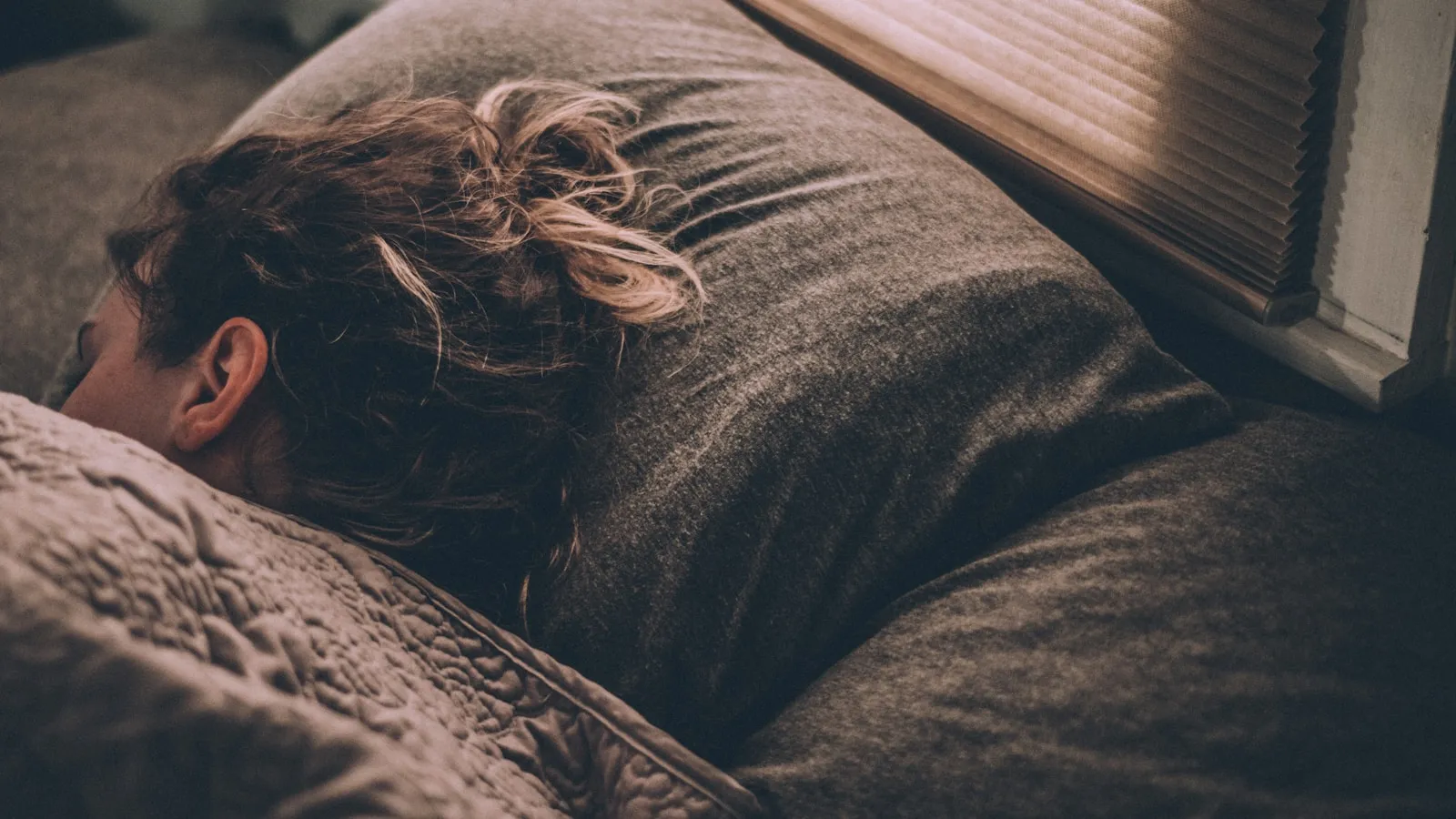
Alcohol makes you fall asleep faster and rest worse. That is not a contradiction. They are two different halves of the night: the first gets deeper, the second falls apart (PMID 23347102).
Your watch sees it too. At a high dose, recovery during the first three hours of sleep dropped by 39.2 percentage points (PMID 29549064).
Why does alcohol make you fall asleep faster?
Alcohol has a sedative effect on your central nervous system. It boosts the inhibitory messenger GABA and dampens excitatory glutamate signalling. That shortens the time it takes to fall asleep, at every dose studied (PMID 23347102). You feel that effect, and it is why a nightcap seems so convincing.
The problem lies in what happens next.
What does alcohol do to your sleep stages?
Your body breaks the alcohol down over the course of the night. As soon as it does, the brake swings the other way. The nervous system rebounds, sleep becomes lighter and choppier, and you surface more often without always remembering it.
REM sleep, when you dream and when memory is consolidated, gets delayed. At higher doses it also gets shorter.
| What changes | First half of the night | Second half of the night |
|---|---|---|
| Time to fall asleep | Shorter, at every dose | Not applicable |
| Deep sleep | Increases | Decreases |
| REM sleep | Delayed | Shorter at higher doses |
| Waking up | Little | Clearly more disruption |
| Recovery by heart rate variability | Low dose 9.3 points lower, moderate dose 24.0, high dose 39.2 (PMID 29549064) |
That last row comes from a study of 4,098 Finnish employees, measured with the same kind of sensor that sits in a sports watch. It explains why your recovery score goes red after two glasses even though you feel you slept fine.
Why do you wake at three in the morning?
Because the alcohol has run out. The sedative effect fades faster than the night lasts. Your nervous system answers with a rebound: lighter sleep, a higher heart rate and a greater chance of jolting awake. Exactly in the second half of the night, where REM sleep normally accumulates.
Say you drink 3 glasses of wine at 20.00. By midnight most of it is processed, because your liver clears roughly one standard drink per hour. You sleep the rest of the night inside the rebound.
Does a nightcap work?
For falling asleep, yes. For the night as a whole, no. And the balance shifts over time: people habituate quickly to the sedative effect, so it takes more and more to get the same drowsiness (PMID 11584549). The body does not habituate to the damage to sleep structure.
A 2024 study showed this neatly. In thirty adults who drank on three consecutive nights, REM sleep stayed reduced on all three (PMID 38205895). The harm repeated itself rather than fading.
Does alcohol worsen snoring and sleep apnoea?
The research does point that way. Across 21 studies, higher alcohol intake was associated with a 25 percent greater risk of sleep apnoea (PMID 29458744). The muscles in your throat relax, so the airway collapses more easily.
The authors note honestly that there are signs of publication bias, so read it as a signal rather than an exact figure. The Dutch Hersenstichting likewise lists alcohol as a factor that undermines sleep quality.
Why do you sleep better without alcohol?
Because the second half of the night stays intact. You may fall asleep a little more slowly, but you lose the rebound, the fragmentation and the REM deficit. After a week or two without alcohol, most people notice they wake up more rested rather than that they sleep longer.
I hear that more often than any other effect from people who cut back. The clock barely changes. The feeling does.
What a sleep tracker does not measure
A tracker shows you that your night was worse. It says nothing about your drinking pattern over the past weeks, and that is exactly what blood testing looks at. CDT responds to heavy use over roughly two to three weeks, and is the most alcohol-specific of the routine markers.
If you want that measured objectively, a CDT test for alcohol can quantify your value. How it compares with EtG and with a liver value is set out in detecting alcohol and in gamma-GT too high.
If you mainly notice the effect after one heavy night, binge drinking is the piece that covers it.
Every blood test result at Zuivertest includes a professional assessment by a BIG-registered doctor. Discuss your results with your GP before making treatment decisions.
Sources
- Ebrahim I.O. et al., "Alcohol and sleep I: effects on normal sleep", Alcoholism: Clinical and Experimental Research, 2013 (PMID 23347102)
- Pietilä J. et al., "Acute Effect of Alcohol Intake on Cardiovascular Autonomic Regulation During the First Hours of Sleep", JMIR Mental Health, 2018 (PMID 29549064)
- McCullar K. et al., "Altered sleep architecture following consecutive nights of presleep alcohol", Sleep, 2024 (PMID 38205895)
- Roehrs T. and Roth T., "Sleep, sleepiness, and alcohol use", Alcohol Research and Health, 2001 (PMID 11584549)
- Simou E. et al., "Alcohol and the risk of sleep apnoea: a systematic review and meta-analysis", Sleep Medicine, 2018 (PMID 29458744)
- Hersenstichting, information on sleep and the brain (hersenstichting.nl)
Author