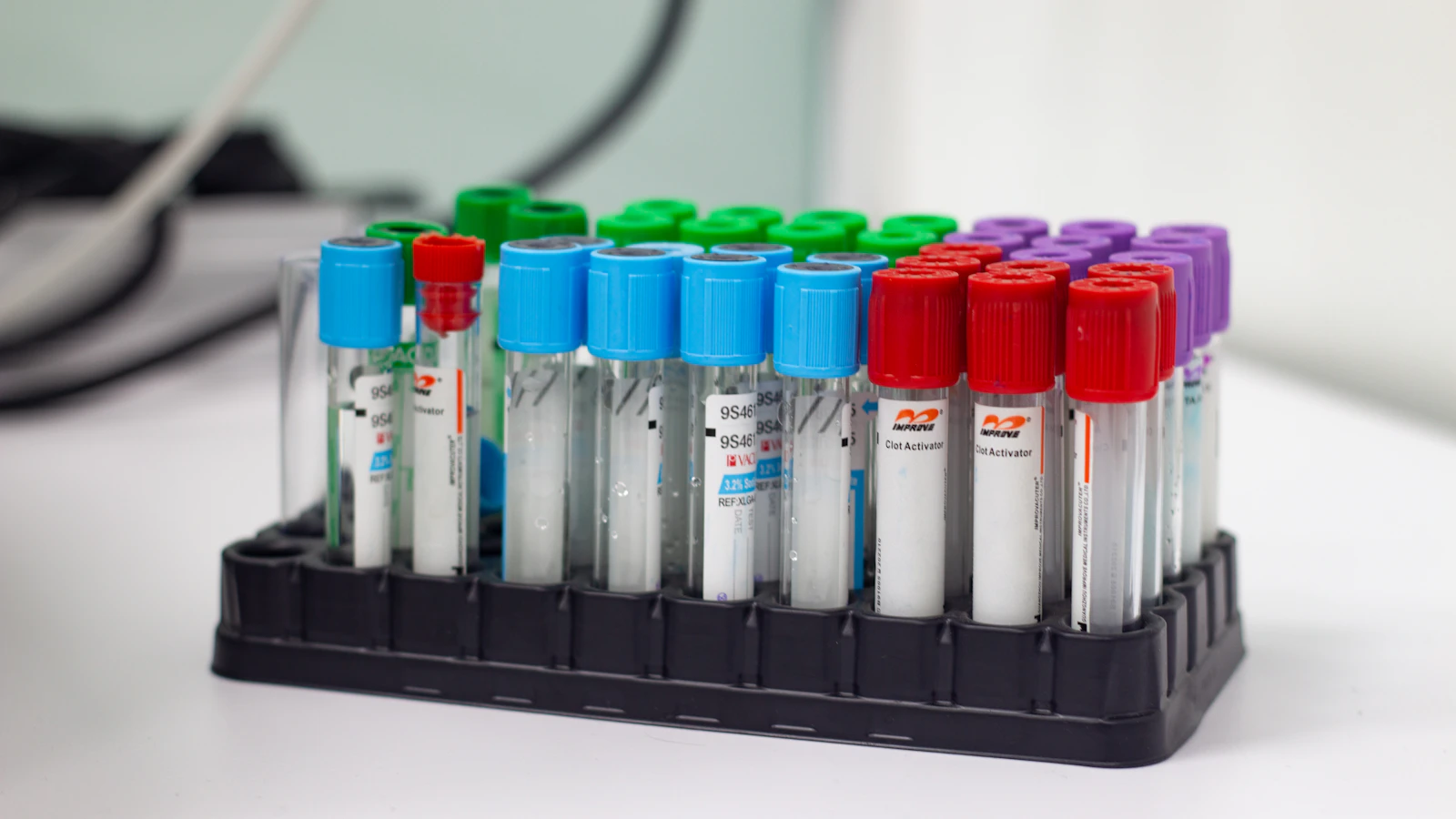
"How long is it still in my body?" It is the question asked most often before a drug test at work, for the CBR (the Dutch driving licence authority) or out of personal reassurance. The honest answer is that no single number is correct for everyone. The detection window depends on the substance, on the test material (urine, blood, saliva or hair) and on the person. What is possible is to give a reliable range per substance and per matrix. That is what this overview does.
One thing we want to set straight at once: a laboratory test does not measure "yes or no", but a concentration. The lab compares that concentration with an agreed cut-off value. That makes a certified lab test more reliable than a test strip with a faint line, and easier to defend if a result is disputed. What a cut-off involves exactly and why it differs per substance is explained in what is a cut-off value.
Four types of test material, four windows
The same substance is detectable far longer in urine than in blood or saliva, and longest of all in hair. That is because each matrix measures something slightly different. Blood and saliva contain the substance itself for as long as it is still circulating; urine mainly contains the breakdown products the kidneys excrete; hair locks the substance into the hair shaft as the hair grows, about one centimetre per month. Roughly, this order applies:
- Blood and saliva show recent use: usually a few hours to about a day. This is the window closest to "is someone under the influence now". Saliva is also simple to collect under supervision, which makes tampering difficult.
- Urine is the standard for most workplace and screening situations: depending on the substance about 1 to 4 days, and far longer for cannabis with frequent use. Urine is cheap, broadly validated and suitable for a panel covering several substances at once.
- Hair looks back furthest, up to about 90 days, and shows a pattern of use over months rather than a snapshot. A hair test is therefore good for distinguishing occasional from structural use, but less suitable for proving use from yesterday.
The choice of material therefore determines which question you answer. For "was someone recently under the influence" saliva fits; for "has there been use in the past few days" urine; for "is there a pattern over months" hair. Which material fits which situation best is developed further in which drug test fits you.
Detection window per substance
The table below summarises the common guide values for single to occasional use. These are ranges, not guarantees: with frequent use, a high dose or a slow metabolism the times increase. The breakdown products a lab measures (for example benzoylecgonine for cocaine or THC-COOH for cannabis) often stay detectable longer than the substance itself.
| Substance | Blood / saliva | Urine | Hair |
|---|---|---|---|
| Cannabis (THC), single use | hours to ± 1 day | ± 1 to 3 days | up to ± 90 days |
| Cannabis (THC), frequent | several days | up to ± 30 days | up to ± 90 days |
| Cocaine | hours to ± 1 day | ± 1 to 4 days | up to ± 90 days |
| Amphetamine (speed) | hours to ± 1 day | ± 1 to 3 days | up to ± 90 days |
| MDMA (ecstasy) | hours to ± 1 day | ± 1 to 3 days | up to ± 90 days |
| Ketamine | ± 1 day | ± 1 to 3 days | up to ± 90 days |
| Opiates (morphine, codeine) | hours to ± 1 day | ± 1 to 3 days | up to ± 90 days |
| Heroin (via 6-MAM) | a few hours | ± 8 hours to 1 day | up to ± 90 days |
| Benzodiazepines (long-acting) | hours to several days | ± 1 day to 4-6 weeks | up to ± 90 days |
| Methadone | ± 1 day | ± 3 to 7 days | up to ± 90 days |
| Magic mushrooms (psilocin) | a few hours | up to ± 1 day | rarely measured |
| LSD | ± 6 to 12 hours | ± 1 to 3 days | rarely measured |
For the details per substance, read the separate overviews: cannabis (THC), cocaine, amphetamine (speed), MDMA (ecstasy) and ketamine. We also have separate overviews for opiates (heroin, morphine, codeine), benzodiazepines, methadone, magic mushrooms (psilocybin) and LSD. Less common, but covered separately as well: PCP, 2C-B, synthetic cannabinoids (spice), barbiturates, phenibut and nicotine (cotinine).
Two things stand out in this table. Cannabis is the outlier: because of storage in fat tissue, the urine window with daily use rises to weeks, while the other substances are gone within a few days. And hair shows roughly the same long window for almost every substance, because detectability there does not depend on breakdown but on hair growth. That explains why an employer wanting to rule out "recent use" chooses a different material from an authority wanting to see a pattern over months.
Why does the window differ per person?
Four factors account for most of the variation. First, frequency and dose: someone who uses regularly builds up a reservoir, especially with fat-soluble substances such as THC. Second, metabolism, which varies per person and with age. Third, fluid intake and kidney function, which determine how quickly breakdown products leave through the urine. And fourth, the sensitivity of the test and the chosen cut-off value: the lower the cut-off, the longer a substance formally stays detectable.
The idea that drinking a lot of water reliably "flushes out" a result is incorrect: dilution lowers the concentration temporarily, but a certified lab recognises a diluted sample by, among other things, the creatinine level and the specific gravity. A sample that is too diluted is marked invalid and has to be repeated. The same applies to so-called detox kits: there is no product that makes a reservoir in fat tissue or a recorded hair measurement disappear faster. The only factor that genuinely shortens the window is time.
Detectable is not the same as under the influence
A common misconception is that a positive result proves someone was under the influence at work. It does not. Cannabis can still appear in urine days after the last use, while the intoxicating effect is long gone. A urine result shows exposure within a window, not current impairment. Anyone wanting to know whether someone is under the influence right now gets closer with a saliva or blood test. For most workplace questions urine is enough, but it is important to understand what the result does and does not say before drawing conclusions from it.
What do the figures say about use in the Netherlands?
The Trimbos Institute maps substance use in the Netherlands every year in the National Drug Monitor. It shows that cannabis is by far the most used illegal substance, followed by cocaine and ecstasy. The RIVM additionally publishes figures on health incidents linked to substance use. For longer-term health risks, the WHO points to the link between frequent use and problems with, among other things, the heart and mental health. These sources say nothing about how long a substance is detectable in your body, but they do show why employers and the CBR use testing.
Screening and confirmation: two steps
A reliable result almost always comes about in two steps. The first step is an immunoassay screening: a fast, sensitive test that gives a first indication per substance group. That screening is deliberately set wide, so it misses little, but as a result it can also react to related substances or medicines. The second step is confirmation with a more precise method, which identifies and quantifies the exact substance. Only after that second step is a result defensible. A test strip you use at home goes through only the first step, and that is exactly why the outcome does not hold up if disputed. The difference between a home test and a lab test is developed in home drug test versus lab test.
The cut-off value plays a role in both steps. A low cut-off means even small amounts already test positive, which lengthens the window; a higher cut-off excludes traces and focuses on meaningful use. Employers and authorities choose the cut-off that fits their question. That is why the same person, with the same sample, can get a different result at two different cut-offs, without either test being "wrong".
The window and the legal context
A detection window says something different from "someone was under the influence at work". Cannabis can still be detectable in urine days after the last use, while the effect is long gone. That is why the choice of test material matters: saliva is closest to current use, urine to use in the past few days. An employer may not test at will. Under the Arbowet (the Dutch working conditions act) and the privacy rules overseen by the Dutch Data Protection Authority (Autoriteit Persoonsgegevens), strict conditions apply, and health data is extra protected. For the driving licence, the CBR uses its own assessments and timeframes. What an employer may and may not do is explained in workplace drug testing: what your employer may do.
Which test fits which question?
The right test depends on what you want to know. If you want to rule out one specific substance, a targeted screening is enough, for example for cocaine, amphetamine or ketamine. If you want a broader picture, you choose a panel. We explain the difference between the variants in 5-panel versus 10-panel. Which material fits your situation, urine, saliva or hair, is covered in which drug test fits you.
Frequently asked questions
Does drinking a lot of water help to pass a test?
Not reliably. Dilution lowers the concentration temporarily, but a certified lab recognises a diluted sample by, among other things, the creatinine level and can mark it invalid. A reservoir in fat tissue, as with cannabis, does not disappear because of it.
Which test fits "is someone under the influence now"?
Saliva and blood sit closest to current use. Urine shows use in the past few days and says less about the moment itself. Hair, by contrast, shows a pattern over months.
How long before a planned test should I stop?
There is no safe number for this, because the window varies per substance, per matrix and per person. The table above gives guide values, but with frequent use the times increase. The only factor that genuinely shortens the window is time.
The windows in this overview are guide values and not a guarantee; the outcome varies per person. Every test result at Zuivertest includes a professional assessment from a BIG-registered doctor. If you have concerns about your health or about substance use, discuss this with your GP. GP, out-of-hours post or laboratory test sets out where to go with which question. If you would rather first read which assumptions do not hold, seven misconceptions about drug testing covers the most common ones.
Author
Zuivertest
Related Tests
Related Posts
7 misconceptions about drug tests (and what is actually true)
3-MMC: effects, duration and the comedown that follows