Amphetamine Screening
Individual amphetamine screening with laboratory confirmation.
Add to your order
No referral needed
Added to your order
Click the button to view your cart
Included Substances
1 substancesThis test screens for the presence of amphetamines in urine. Detection is typically possible within a window of approximately two to four days after use, though individual variation may occur.
Why this test?
This screening detects amphetamines and related compounds in urine. The approximate detection window is two to four days, though this may vary depending on individual factors such as metabolism, hydration, and dosage. It is worth noting that certain prescription medications, including some used for ADHD, may contain amphetamine-based compounds and could produce a positive screening result.
Who is this test for?
This test may be relevant for:
- Individuals who wish to verify the presence or absence of amphetamines for their own information
- People who need a focused, single-substance screening for amphetamines
- Anyone seeking documentation of an amphetamine-specific screening result
What is tested?
This test measures a single marker:
- Amphetamines: measured in urine, expressed in ug/l. The test detects the presence of amphetamine and related compounds above the laboratory's reporting threshold. The approximate detection window is two to four days. Note: some prescription medications (such as certain ADHD medications) contain amphetamine-based compounds and may produce a positive result.
What can this test tell you?
A positive result indicates that amphetamines were detected above the laboratory's reporting threshold, suggesting that the substance may have been present in the body within the detection window. A negative result means that amphetamines were not detected above the threshold at the time of sample collection.
If a positive result is obtained, confirmation testing may be performed. It may be relevant to mention any prescription medications to a healthcare provider, as some medications can influence the screening outcome. The test provides information about detection or non-detection and does not indicate dosage or frequency of use.
How is the sample collected?
The test requires a urine sample, collected at a certified sample point (afnamepunt). A mid-stream sample is collected under the guidance of trained personnel. The process is straightforward and typically takes only a few minutes.
When is this test useful?
This test may be considered when:
- A focused screening for amphetamines is desired
- Personal insight into whether amphetamines are present is wanted
- Documentation of an amphetamine-specific screening result is needed
What do the results mean?
The result is reported as detected or not detected. A positive result suggests that amphetamine use may have occurred within the approximate detection window (two to four days). A negative result indicates that the substance was not found above the reporting threshold.
Individual factors such as metabolism, hydration, and prescription medication use may influence the result. If you take prescription medications that contain amphetamine-based compounds, this information may be relevant when discussing results with a healthcare provider.
Preparation
Collect a mid-stream urine sample at the sample point. Hydrate normally beforehand. Over-hydration may dilute the sample and could affect the reliability of the result. If you take prescription medications that could affect the screening, you may wish to note this for reference when discussing results with a healthcare provider.
What happens after the results?
Results are typically available within a few working days. The report indicates whether amphetamines were detected or not detected.
If the initial screening produces a positive result, confirmation testing using a more specific analytical method may be performed. The final report includes the confirmed outcome. A healthcare provider can help interpret the results in context, particularly if prescription medications may have influenced the screening.
Frequently Asked Questions
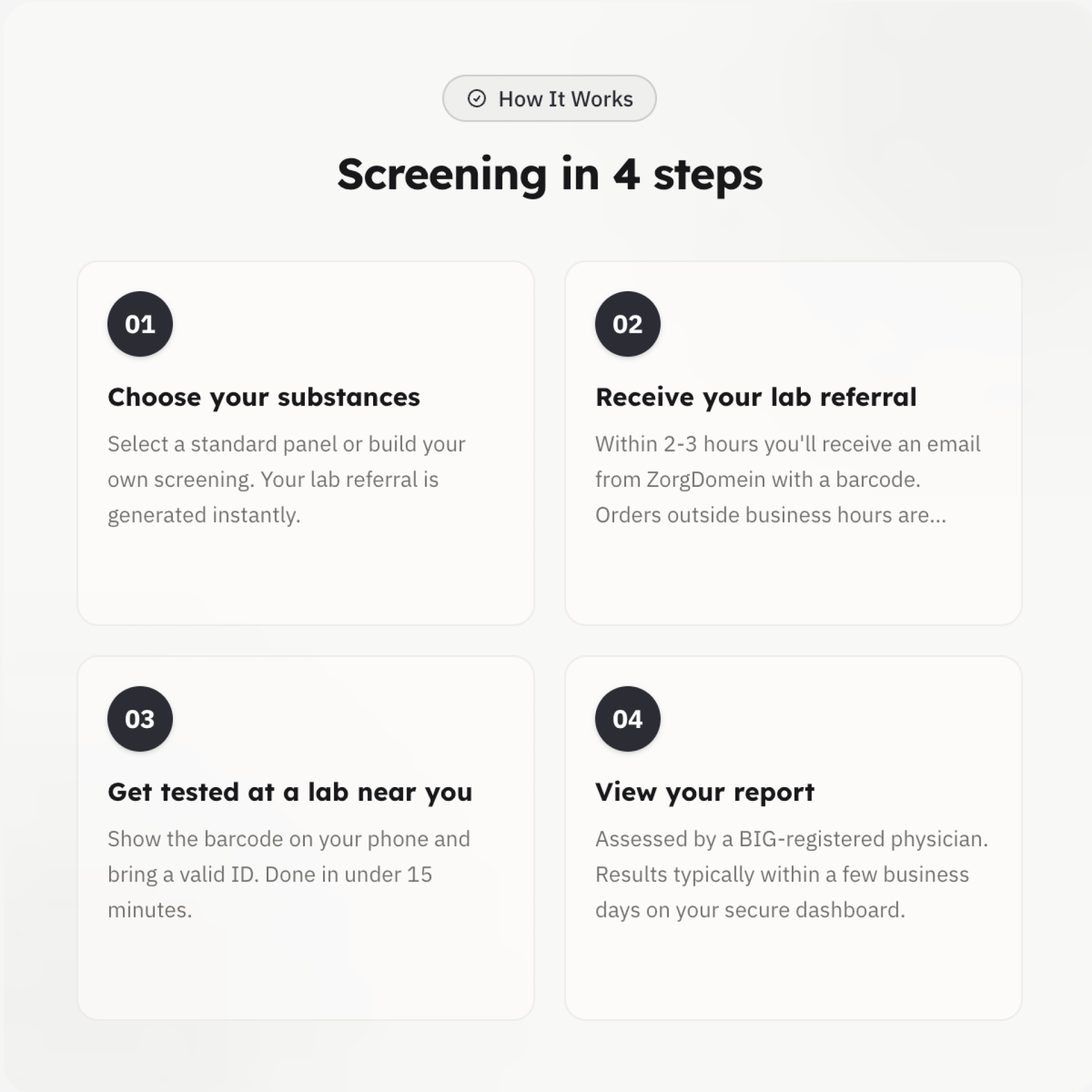
Screening in 4 steps
No referral, no waiting, no questions. Order, test, and receive your results on your dashboard.
Choose your substances
Select a standard panel or build your own screening. We then create your lab referral.
Receive your lab referral
Within 1 business day you'll receive an email from ZorgDomein with a barcode. Orders outside business hours are processed from the next business day.
Get tested at a lab near you
Show the barcode on your phone and bring a valid ID. Done in under 15 minutes.
View your report
Assessed by a BIG-registered physician. Results typically within a few business days on your secure dashboard.
Choose your substances
Select a standard panel or build your own screening. We then create your lab referral.
Receive your lab referral
Within 1 business day you'll receive an email from ZorgDomein with a barcode. Orders outside business hours are processed from the next business day.
Get tested at a lab near you
Show the barcode on your phone and bring a valid ID. Done in under 15 minutes.
View your report
Assessed by a BIG-registered physician. Results typically within a few business days on your secure dashboard.
Always a location near you
With 700+ certified phlebotomy points across the Netherlands.
What We Screen For
This panel screens for 1 substances to give you comprehensive results.
An amphetamines urine test is a qualitative screening that detects the presence of amphetamine, methamphetamine, MDMA (ecstasy), and related compounds or their metabolites in urine. This test covers a broad class of central nervous system stimulants.
Learn moreAmphetamines
Drug ScreeningAn amphetamines urine test is a qualitative screening that detects the presence of amphetamine, methamphetamine, MDMA (ecstasy), and related compounds or their metabolites in urine. This test covers a broad class of central nervous system stimulants.
Amphetamine detection is a standard component of workplace drug screening, clinical toxicology assessment, and substance use treatment monitoring. These substances affect the cardiovascular and central nervous systems. It is important to note that certain prescribed medications, such as those for ADHD, may produce a positive result. Clinical context and confirmatory testing are essential for accurate interpretation.
Related biomarkers
Biomarkers often explored alongside this test for a fuller picture.
2C-B
A 2C-B urine test is a qualitative screening that detects the presence of 2C-B (4-bromo-2,5-dimethoxyphenethylamine) or its metabolites in urine. 2C-B is a synthetic psychedelic phenethylamine with stimulant and hallucinogenic properties.
3-MMC
A 3-MMC urine test is a qualitative screening that detects the presence of 3-methylmethcathinone (3-MMC) or its metabolites in urine. 3-MMC is a synthetic cathinone with stimulant and empathogenic properties.
6-MAM (Heroin Marker)
A 6-MAM urine test is a qualitative screening that detects the presence of 6-monoacetylmorphine (6-MAM) in urine. 6-MAM is a unique metabolite of heroin (diacetylmorphine) and its presence confirms heroin exposure specifically, rather than general opiate use.
Alcohol (EtG)
An EtG urine test is a qualitative screening that detects the presence of ethyl glucuronide (EtG), a direct metabolite of ethanol. EtG can be detected in urine for up to 80 hours after alcohol consumption, making it a sensitive biomarker for recent alcohol exposure.
Barbiturates
A barbiturates urine test is a qualitative screening that detects the presence of barbiturate compounds or their metabolites in urine. Barbiturates are a class of sedative-hypnotic medications that act on the central nervous system.
Benzodiazepines
A benzodiazepines urine test is a qualitative screening that detects the presence of benzodiazepine compounds or their metabolites in urine. Benzodiazepines are a widely prescribed class of anxiolytic and sedative medications.
Related Panels
Explore more screening panels that might be relevant for you.
Alcohol (CDT) Test
CDT biomarker test designed to indicate chronic alcohol consumption patterns.
Cocaine Screening
Individual cocaine metabolite screening with laboratory confirmation.
Ketamine Screening
Individual ketamine metabolite screening with laboratory confirmation.
This test not quite right?
Build your own blood test from 21+ individual biomarkers — choose exactly what you need.
Have a question?
Our team is happy to help. Ask your question and we'll respond as soon as possible.