A test strip from the drugstore costs a few euros and gives a line or not within five minutes. A laboratory test costs more and you wait a day or longer for the result. The temptation to choose the strip is understandable, but the question that matters is: what do you need the result for? For your own reassurance at home a strip is often fine. As soon as the result has to mean something to someone else, be it an occupational health service or a judge, the story changes.
We prefer to say it straight: a home strip is an indication, not proof. That is not a sales pitch, but the difference between a screening and a confirmed measurement. Whoever knows that difference chooses the right tool for the right question.
What a test strip does and does not do
A test strip is an immunoassay: antibodies react to a substance group and colour a line or not. That is fast and cheap, but it has two limitations. The strip only gives "above or below the cut-off", never a value. And the antibodies can cross-react, so an innocent medicine or food gives a false positive line. Which substances those are is in false positive drug test.
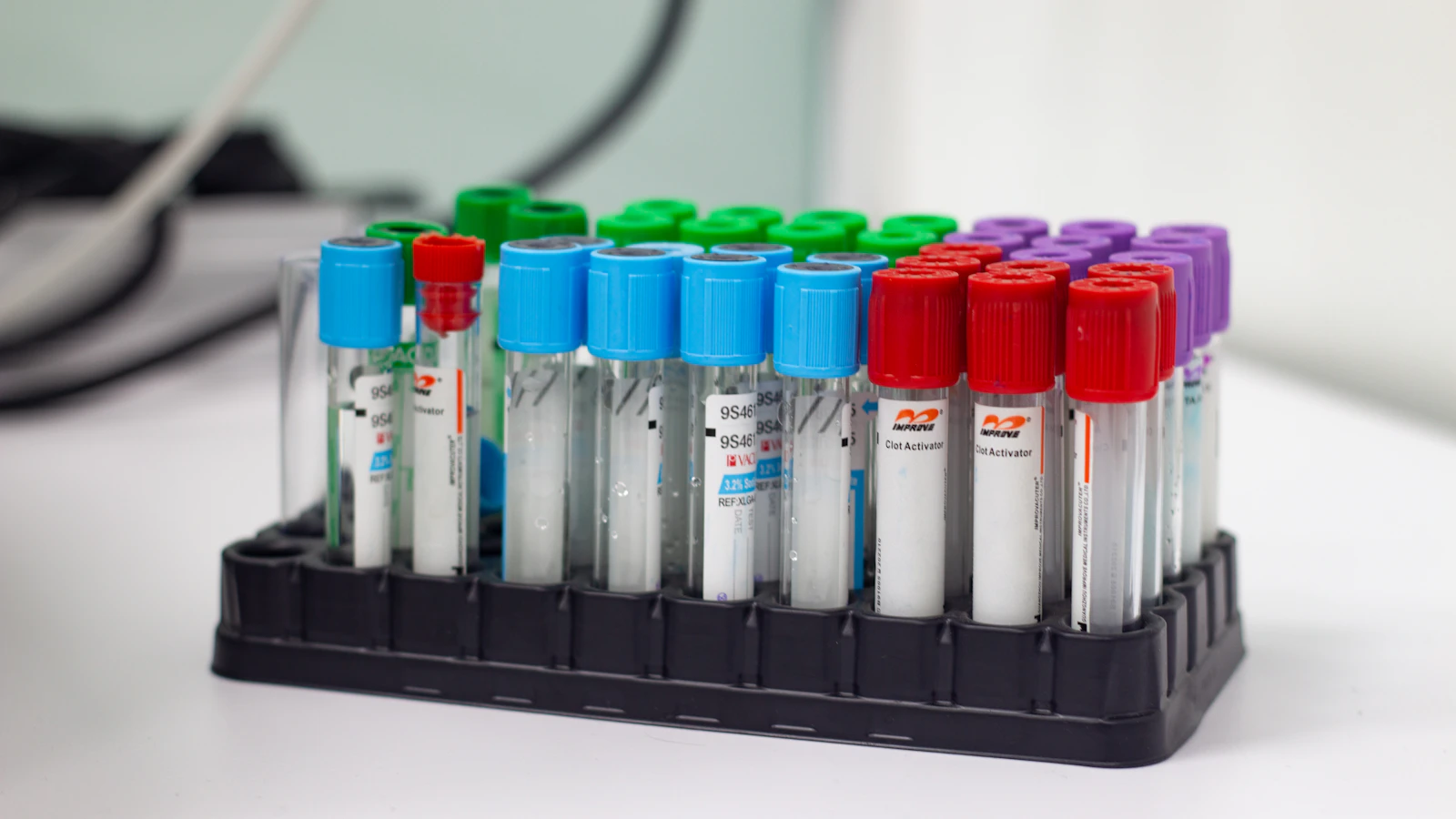
After a positive screening, a laboratory performs a confirmation analysis with GC-MS or LC-MS. Those methods measure the substance itself, not an antibody reaction, and give an exact concentration. That is the step that lifts a result from "probable" to "established".
| Feature | Home test strip | Lab test (GC-MS / LC-MS) |
|---|---|---|
| Type of result | Line: positive or negative | Quantified value in ng/mL |
| Specificity | Limited, cross-reaction possible | High, substance-specific |
| Confirmation | No | Yes, second method |
| False positive risk | Real | Very small after confirmation |
| Speed | Minutes | Hours to days |
| Legal evidential value | Barely | Suitable as substantiated proof |
How reliable are test strips really?
With correct use, quality strips achieve a reasonable sensitivity for the classic substances. But "reasonable" is not the same as "provable". The World Health Organization (WHO) and the Trimbos Institute stress in their guidelines that a positive screening should always be confirmed before any consequences are attached. A single line is therefore never the endpoint of a serious procedure.
On top of that, strips often do not recognise newer substances. Designer drugs such as 3-MMC fall outside the antibodies a standard strip is built on, so the result stays negative while the substance is in fact present. More on this is in how long is 3-MMC detectable.
Sensitivity and specificity: two concepts that help you choose
Two concepts explain why a lab is more reliable than a strip. Sensitivity is the ability to recognise use when it is there: too low a sensitivity gives false negative results. Specificity is the ability to correctly mark non-use as negative: too low a specificity gives false positive results. A home strip is deliberately set wide to miss little, and thereby sacrifices specificity. A lab combines a sensitive screening with a specific confirmation, and reaches a higher level on both points. The RIVM and the Trimbos Institute stress that precisely that second step, the confirmation, makes the difference between an indication and a result you can build on. For a result without consequences this weighs less heavily, but as soon as something depends on it, it is the decisive factor.
Where a home strip goes wrong
Most errors with a home test come not from the strip itself, but from how it is used. A few common pitfalls:
- Timing. Testing too early or too late falls outside the detection window. With a substance with a short window, such as GHB, that window is sometimes only a few hours. See how long is GHB detectable.
- Dilution. Drinking a lot just before the test lowers the concentration in urine and can make a result wrongly negative.
- Storage and shelf life. An expired or wrongly stored strip gives unreliable results.
- Reading. A very faint line is hard to interpret; with a rapid test that is often the difference between "doubt" and "certainty".
A laboratory counters these error sources with a controlled collection, a fixed cut-off and a confirmation step. What that threshold means exactly is in what is a cut-off value.
Which do you choose when?
- Personal certainty, low stakes. If you want a quick indication for yourself, a test strip usually suffices.
- Result with consequences. If a job application, a workplace matter or a legal trajectory is at play, a confirmed lab result is the only defensible choice.
- Doubt about a positive strip. A positive home strip always calls for a lab confirmation before you draw conclusions from it.
A lab sets every value against a fixed threshold; what that threshold means is in what is a cut-off value, and the broader overview of detection times is in how long do drugs stay detectable. A confirmed measurement is available via the core 5-panel or the extended 10-panel.
Every test result at Zuivertest includes a professional assessment from a BIG-registered doctor. A drug test can give clarity, but does not replace medical advice. For treatment decisions, discuss your results with your GP.
Sources
- Trimbos Institute, National Drug Monitor, substance use in the Netherlands (trimbos.nl)
- RIVM, information on drugs and detection (rivm.nl)
- World Health Organization (WHO), guidance on drug testing and confirmation (who.int)
Autor
Zuivertest
Powiązane badania
Powiązane artykuły

7 misconceptions about drug tests (and what is actually true)

3-MMC: effects, duration and the comedown that follows